Can an AI phone agent apply store credit instead of a cash refund?
AI phone agent store credit vs refund: yes, with authorized access and customer agreement. See the Shopify workflow, safeguards, and checks before launch.
November 12, 2026

Yes, an AI phone agent can apply store credit instead of a cash refund when its connected system supports issuing credit, the merchant authorizes that action, and the resolution meets the applicable policy and customer rights. Offering credit is not the same as issuing it: the agent must obtain any required customer agreement and confirm that the credit was actually recorded.
TL;DR
- AI phone agent store credit vs refund: automate only authorized resolutions, with clear customer agreement and confirmed execution.
- Shopify merchants should separate explaining store credit, recording acceptance, and issuing the balance.
- Avasales serves Shopify phone support and abandoned-cart recovery; confirm store-credit execution before enabling that workflow.
- Never label a pending credit request as a completed refund.
Can an AI phone agent apply store credit instead of a cash refund?
Yes, but the connected transaction system must support the action. A conversational answer alone does not create a store-credit balance or return money to a payment method. Your workflow needs a permitted action, the correct customer account, and a confirmed result.
For merchants evaluating Avasales, the offer includes a 7-day free trial, setup in minutes, and zero commission on recovered revenue. Treat store-credit execution as a specific capability to confirm before enabling it, rather than assuming it follows from general refund support.
Store credit
- Best for: Customers who accept credit toward another purchase
- Benefit: Keeps value available for shopping with your store
- Limitation: Does not return money to the original payment method
- Required confirmation: Credit recorded against the intended customer account
Refund to the original payment method
- Best for: Eligible customers seeking money back
- Benefit: Returns funds through the payment workflow
- Limitation: Processing and customer receipt are separate events
- Required confirmation: Refund transaction accepted by the payment system
Human review
- Best for: Disputed eligibility or an unsupported action
- Benefit: Lets an authorized person resolve exceptions
- Limitation: Requires additional handling
- Required confirmation: Named owner and an accurate pending status
This 2026 decision framework separates what the customer wants from what the agent is authorized to execute. Store credit is an option to explain clearly, not a substitute to select merely because it keeps money in the business.
Why this matters
Your customer hears a promise; your systems record a transaction. Those must agree. If the agent says a credit is ready when it has only submitted a request, the next shopping attempt exposes the mismatch.
The distinction also matters for reporting. A customer accepting store credit, a refund being submitted, and a customer placing another order are different outcomes. Record them separately instead of treating every resolved conversation as retained revenue.
Automate the approved resolution, not the assumption that every caller should accept credit. Give customers a clear explanation of the eligible options, then execute only the option they select and your systems permit.
Store credit: explain the balance before applying it
Store credit gives a customer value to use with your store rather than returning funds through the original payment method. Explain the applicable redemption terms before asking for acceptance. Do not invent expiration dates, exclusions, or promises about where the credit works.
Your agent should identify the order and customer, establish eligibility, and state the proposed resolution in plain language. A customer asking about credit has not necessarily agreed to receive it. Require an affirmative choice before submitting the action.
For your 2026 call script, make the destination explicit: credit with the store, not money returned to the customer's card. Read back the amount from the approved transaction data rather than calculating a new entitlement from the conversation.
Best for: eligible customers who choose to shop with your store again. The benefit is a reusable balance; the limitation is that credit does not meet a request for money back unless that resolution is appropriate and accepted.
Cash refunds: confirm the transaction, not the arrival date
A refund to the original payment method follows a different transaction path from store credit. Your agent must use the supported refund action and describe its actual status. A successful submission does not establish when the customer will see funds in their account.
Keep return approval separate from refund completion. If your policy requires an item to be received or inspected before a refund, the agent should describe that requirement without claiming the payment has already been reversed.
You can examine that distinction further in the guide to whether AI voice agents can process Shopify refunds. For implementation, require evidence of the completed transaction rather than relying on a call summary alone.
Best for: eligible customers seeking a return of funds. The benefit is alignment with that request; the limitation is that the agent cannot promise a settlement date without reliable information from the relevant payment system.
Human review: preserve the customer's request
Route a case to an authorized person when the requested action exceeds the agent's permissions, eligibility is disputed, or the transaction result is uncertain. The handoff should retain the customer's preferred resolution, not replace it with whichever option the automation can execute.
A useful handoff includes the order reference, verification status, requested resolution, policy question, and any attempted action. If a transaction was submitted, record its status so the next person does not repeat it unnecessarily.
Best for: exceptions and unresolved disputes. Human review adds handling, but it prevents an unsupported automated decision from becoming a financial promise to the customer.
Why store-credit automation varies
The right workflow depends on operational controls, not how confidently the agent speaks. Check these factors before authorizing financial actions:
- Policy scope: Define which cases qualify for credit, refunds, or review. A policy explanation must match the resolution you actually permit.
- Action access: Confirm that the connected system can issue the intended resolution. Read access to an order does not establish permission to change a balance.
- Customer identity: Apply your approved verification process before exposing order details or changing customer value.
- Customer choice: Record acceptance when credit is offered as an alternative. Preserve a declined offer without repeatedly pushing it.
- Transaction state: Distinguish requested, submitted, completed, and failed actions. An ambiguous response needs reconciliation before another attempt.
- Exception ownership: Assign a person or team to cases outside the permitted workflow. Customers need a clear next step when automation stops.
These are acceptance criteria for your implementation. They are not evidence that any particular app includes every control by default.
How should you configure the call workflow in 2026?
Use a controlled sequence that separates eligibility, agreement, execution, and confirmation. The conversation should not advance to a completion statement until the transaction system returns a result that supports it.
- Verify identity. Follow your approved verification procedure before discussing protected order information or applying value to an account. Stop the financial action when verification fails.
- Check eligibility. Retrieve the relevant order state and approved policy. If the required facts are unavailable, send the case for review instead of filling the gaps conversationally.
- Confirm choice. Explain the eligible resolution and any applicable terms. Record whether the customer accepts store credit or requests another available option.
- Execute action. Submit only the authorized transaction to the correct account or payment workflow. Keep the transaction reference with the case.
- Confirm result. Describe what the system actually completed. If the action is pending or failed, state that status and identify the next step.
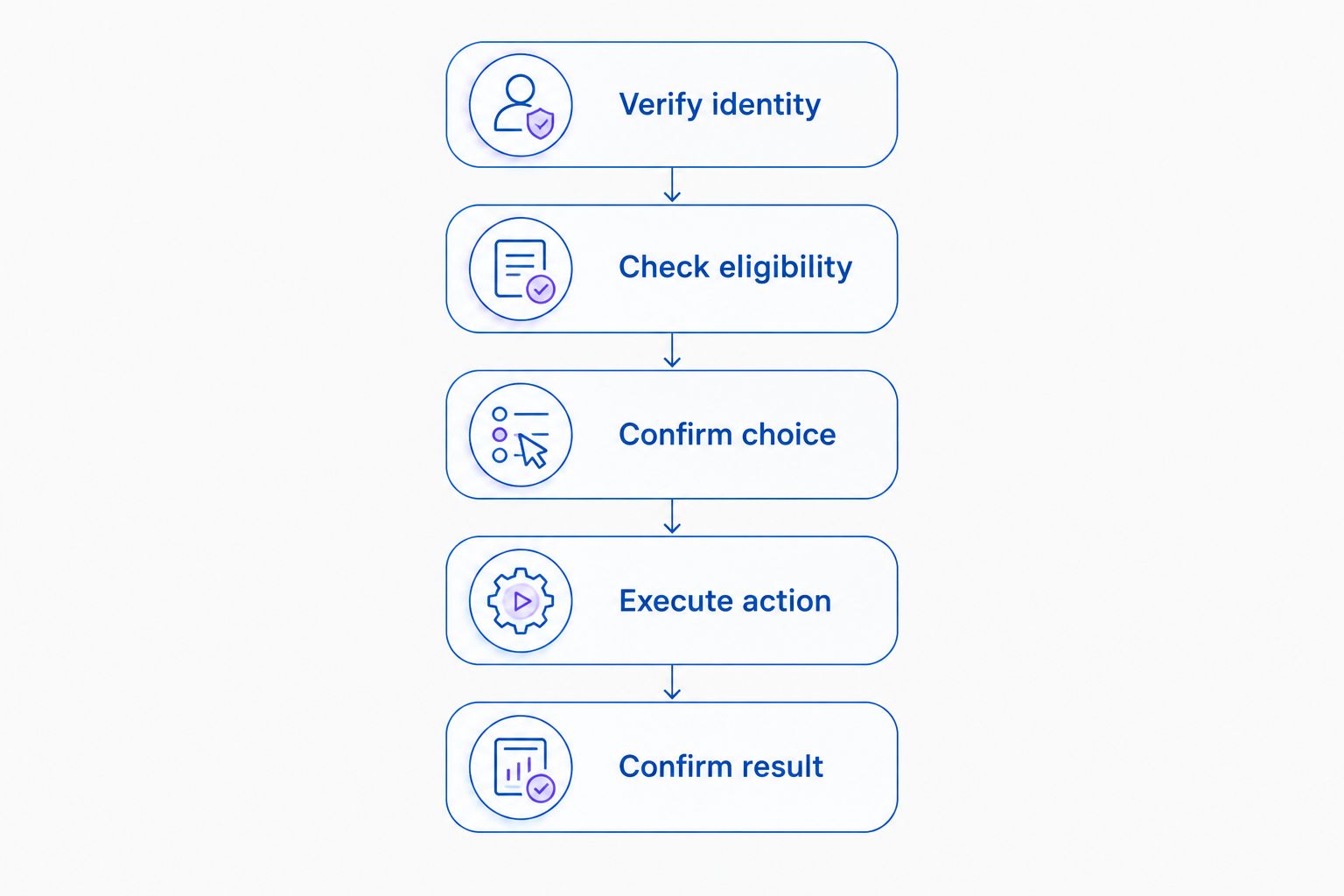
Customer acceptance comes before execution; completion language comes after a confirmed result.
Do not let a polite acknowledgment stand in for authorization. The agent should distinguish a customer understanding the offer from a customer accepting it. That difference belongs in the recorded outcome as well as the spoken exchange.
Keep the same distinction in follow-up messages. A pending request needs pending language; a completed credit needs confirmation of the completed credit. Never use a generic refund confirmation for both.
What should you test before enabling financial actions?
For a 2026 rollout, test both successful transactions and cases where the agent must stop. A clean demonstration proves little if it never includes a declined offer, a failed action, or an interrupted call.
- Credit accepted: Check that the intended account receives the approved credit and that the confirmation matches the recorded outcome.
- Credit declined: Check that the agent preserves the customer's requested alternative without presenting credit as already applied.
- Identity unresolved: Check that the agent stops before disclosing protected details or changing account value.
- Existing resolution: Check that a previously completed refund or credit is recognized before another action is attempted.
- Uncertain result: Check that a timeout produces reconciliation or review, not an automatic second transaction.
- Call interrupted: Check that the case shows whether the transaction happened before the caller disconnected.
Use a pass-or-fail record for each scenario. A fluent conversation does not compensate for the wrong account, duplicate value, or a misleading completion statement.
Where does Avasales fit?
Avasales is best for Shopify merchants seeking phone support and abandoned-cart recovery. Its stated offer includes answering support calls 24 hours a day, resolving orders and refunds, and making outbound abandoned-cart recovery calls.
For this use case, evaluate the financial workflow independently from the quality of the conversation. Ask for a demonstration of store-credit eligibility, customer acceptance, the actual issuing action, and the recorded result. Do not approve automatic credit issuance based only on a demonstration of refund handling.
Use the trial to check the workflow against your store's approved policies. Confirm current plan terms and usage charges in the Shopify App Store before committing. Zero commission on recovered revenue describes the commission policy, not the entire billing arrangement.
Can the agent offer credit when a customer asks for a refund?
Yes, an agent can present store credit as an eligible alternative when your policy and applicable requirements permit it. Explain what the customer receives and obtain any required agreement before issuing it. If the customer declines, preserve the request for the appropriate refund or review path.
What if the agent cannot issue the credit directly?
The agent can explain the eligible option and prepare a request for an authorized person, but it should not say the credit has been applied. Make the pending status explicit. Assign ownership so acceptance of an offer does not become an unattended task.
How do you know whether the call resolved the request?
Check the customer's selected resolution against the transaction record and final communication. A resolved conversation requires an accurate outcome, not simply a call that ended without escalation. Keep incomplete financial actions visible until they are reconciled.
FAQ
Can an AI phone agent issue store credit automatically?
Yes, when the connected system supports issuing credit and the merchant authorizes the action. The workflow must also satisfy eligibility, verification, and any required customer-agreement checks.
Is store credit the same as a cash refund?
No. Store credit provides value for use with the store, while a refund returns funds through the relevant payment workflow. The agent should name the actual resolution rather than treating the terms as interchangeable.
Can my phone agent force a customer to accept store credit?
Do not configure the agent to override applicable refund rights or required customer agreement. Give it an approved policy and an escalation path for disputed eligibility.
Does access to Shopify order data mean the agent can issue credit?
No. Reading an order and executing a financial action are separate permissions. Confirm the supported action and its authorization before enabling it.
Should the agent retry if a credit request times out?
The agent should establish whether the first request succeeded before retrying. An uncertain response is not proof that no credit was issued.
Can Avasales handle Shopify refund calls?
Avasales provides Shopify phone support that includes resolving orders and refunds. Confirm store-credit issuing capability separately before relying on it for an automated credit workflow.
What should I check before launching store-credit calls in 2026?
Check eligibility rules, identity verification, customer choice, transaction permissions, and completion records. Test declined offers and failed actions as well as successful credit issuance.
One last thing
The most useful test is what happens after the transaction response disappears. Interrupt a test call after submission but before spoken confirmation. Your system should still establish whether credit was issued, preserve that result, and prevent an unnecessary repeat action.
A customer calling back should receive an accurate answer about the existing resolution, not restart the financial workflow. Make that recovery behavior a launch requirement.