Can an AI phone agent confirm an order before it ships?
Can an ai phone agent confirm order before shipping? Yes, with current order data and clear permissions. Learn the checks, limits and handoff rules.
November 18, 2026

Yes. An AI phone agent can confirm an order before it ships when it has access to current order details, an approved identity-check process and clear instructions about what it can change. Confirmation does not automatically authorize an address edit, cancellation or warehouse hold; those actions require separate permissions and a connected fulfillment workflow.
TL;DR
- An AI phone agent can confirm an order before shipping, but confirmation and fulfillment authorization are separate actions.
- Require current Shopify order data, customer verification and a recorded outcome before treating a call as complete.
- Avasales offers a 7-day free trial, setup in minutes and zero commission on recovered revenue.
- Test outbound pre-shipment triggers and warehouse controls separately from general phone support.
Why this matters
A customer saying the address is wrong creates an operational task. Your support conversation must reach whoever controls the shipment while a correction is still possible. Otherwise, a successful conversation leaves the original problem untouched.
For your 2026 implementation, define what confirmation means before choosing a calling workflow. The Shopify order data to real-time phone answers workflow addresses the data-access side of that decision. Separately, decide which customer responses require review and who owns that review.
Treat order confirmation as a documented decision about an existing order, not permission to perform every requested change.
Can an AI phone agent confirm an order before it ships?
Yes, provided the workflow connects the conversation to the correct order and checks its current fulfillment state. Use this sequence as an implementation requirement, rather than assuming every phone app includes it.
- Check eligibility. Confirm that the order exists and is still within your store's permitted pre-shipment review window. Exclude orders your fulfillment team can no longer change.
- Verify identity. Apply your approved verification process before disclosing order-specific information. A matching phone number alone should not replace that process.
- Confirm details. Ask the customer to confirm the relevant items, quantities and delivery information. Keep the conversation limited to the purpose of the call.
- Route exceptions. Send address changes, cancellation requests and disputed purchases through their authorized workflows. Do not treat a spoken request as a completed system update.
- Record outcome. Save whether the customer confirmed, requested help, declined verification or did not answer. Make the result visible to the person responsible for the next action.
The workflow needs a final check before any shipment-changing action. An order that was editable when the call started might have moved to a different fulfillment state by the time the customer responds.
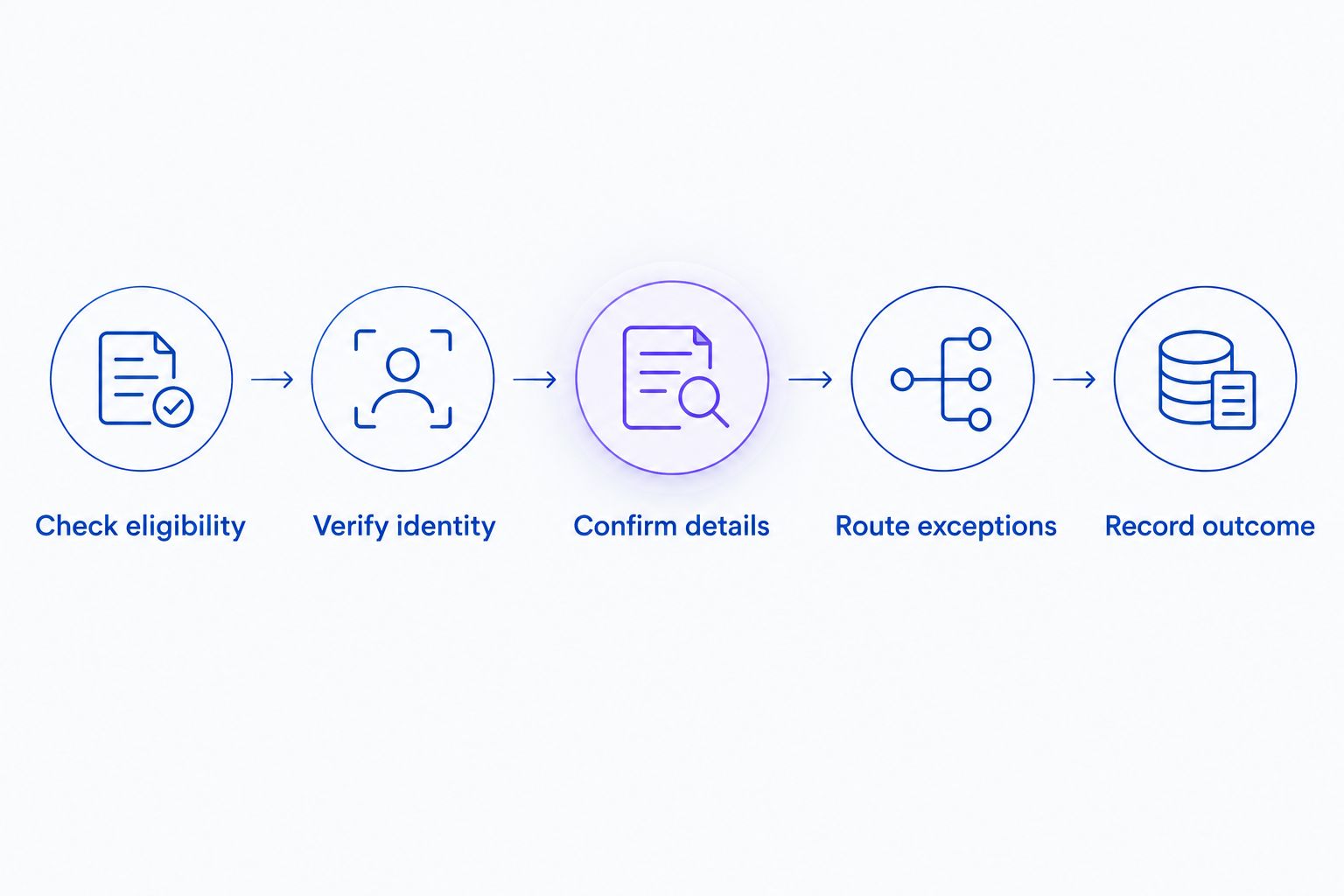
A confirmation call needs an exception route and a recorded outcome.
Choose the right confirmation method
Inbound support, outbound confirmation and staff review serve different needs. Choose according to who starts the conversation and how much authority the situation requires.
Inbound AI support
- Best for: Customers calling to check an existing order
- Advantage: Answers the customer's immediate question
- Limitation: Does not initiate confirmation for customers who never call
Outbound AI confirmation
- Best for: A defined pre-shipment confirmation process
- Advantage: Initiates the requested conversation when the necessary calling workflow exists
- Limitation: Requires an eligible trigger, appropriate calling permissions and unanswered-call rules
Staff review
- Best for: Disputed purchases or requests outside automation permissions
- Advantage: Gives an authorized person control over exceptions
- Limitation: Requires staff availability and a clear queue owner
Use automated confirmation for a bounded task with an explicit outcome. Keep staff review available for requests the automated workflow cannot safely complete.
Do not choose outbound calling simply because a product supports outbound calls for another purpose. Abandoned-cart recovery and confirmation of a placed order require different eligibility rules, information and follow-up actions.
What should the agent actually confirm?
Start your 2026 call specification with the facts needed to resolve the customer's question. Avoid reading every available field just because the system can access it.
- Order reference: Establish which purchase the conversation concerns without exposing unnecessary information before verification.
- Items and quantities: Confirm the relevant order contents, particularly when the customer asks whether a selection is correct.
- Delivery details: Use the store's approved address-check procedure and distinguish a requested correction from a completed correction.
- Current status: State the status available from the connected order record without inventing warehouse progress.
- Next action: Explain whether the order remains unchanged, needs staff review or has an authorized update recorded.
Payment confirmation needs its own rules. Do not ask customers to read full card details aloud, and do not present an order-detail confirmation as a fresh payment authorization.
A useful call ending tells the customer what happened. If the agent only recorded a request, the closing should say that the request awaits review rather than claiming the shipment has been changed.
Why pre-shipment confirmation varies
The right workflow depends on the task and the permissions behind it. Use these factors to assess scope instead of relying on a general claim that an agent handles orders.
- Call direction: Answering an inbound question and initiating an outbound confirmation are separate capabilities to verify.
- Order-data access: The agent needs the relevant order details and a way to handle unavailable information without guessing.
- Action permissions: Reading information, editing an order and requesting a fulfillment hold are different levels of authority.
- Fulfillment ownership: Your store must identify the person or system that can act on a customer's request.
- Exception handling: Unanswered calls, failed verification and disputed purchases need explicit outcomes and escalation rules.
Write an acceptance check for each factor. A product demonstration that reads an order correctly does not establish that a warehouse receives an exception or that an edit is permitted.
Can the agent change an address during the call?
An AI phone agent can change an address only when its connected workflow permits the update and the order remains eligible. Asking the customer to confirm an address is not the same as validating that address or updating the fulfillment record.
Require the agent to distinguish the customer's requested address from the address currently stored. If an authorized update succeeds, the closing can describe that result. If it fails, the conversation must preserve the request and identify the next step.
Never promise that a parcel will reach a corrected address unless the responsible workflow has accepted the change. A support note alone does not establish that the shipment destination changed.
For a 2026 launch, include an address-change test that reaches the actual fulfillment owner. Check the receiving record, not just the call transcript.
Does confirmation release an order for shipping?
Confirmation releases an order only if you explicitly connect that outcome to an authorized release process. A completed call has no independent authority over warehouse operations.
Keep customer confirmation and fulfillment release as separate records or decisions. That separation lets your team distinguish a customer agreeing with the details from a system approving dispatch.
Also define what happens when the customer cannot be reached. Your policy should state whether an unanswered call leaves fulfillment unchanged or sends the order for review. The agent should never invent that decision during a conversation.
What happens when order data is unavailable?
When current order information cannot be retrieved, the agent should stop short of confirming facts it cannot verify. It can explain that the request needs review without making a shipping promise.
Your fallback should preserve the reason for the call, the customer's request and the unresolved question. Assign a clear owner so the customer does not need to restart the explanation with another team.
For shipment-sensitive requests, decide how staff identify that work in the review queue. Do not describe an order as held merely because a ticket or message exists.
Test the workflow before enabling outbound confirmation
Build your 2026 acceptance test around observable outcomes. A natural-sounding call matters, but the decisive question is whether the correct order receives the correct next action.
Use a test plan that includes a normal confirmation, an address correction, a cancellation request, failed identity verification, unavailable order data and an unanswered call. These are test scenarios, not claims about any application's included features.
The handoff between conversation and operations belongs in your broader e-commerce customer support automation design: every request needs an owner, an authorized action and a visible completion state. Without those requirements, a call can end successfully while the customer's request remains unresolved.
For each scenario, inspect the order record and the receiving team's queue. Check whether the saved outcome matches what the customer heard. If the agent says an update succeeded but the record is unchanged, the workflow fails the test.
Repeat the relevant checks whenever you change permissions, fulfillment routing or call instructions. Keep unresolved cases out of automatic shipment decisions until the process produces the intended result.
Where Avasales fits for Shopify merchants
Avasales is best for Shopify merchants seeking an AI phone agent for customer support and abandoned-cart recovery calls. It offers a 7-day free trial, setup in minutes and zero commission on recovered revenue.
Avasales provides AI phone support that answers customer calls 24/7, resolves order and refund requests, and makes outbound abandoned-cart recovery calls. Those stated capabilities make order conversations relevant to its role in your store.
The boundary is specific: support for order requests does not by itself establish an outbound pre-shipment confirmation trigger, an address-edit permission or a warehouse-release integration. Require a demonstration of those exact actions before designing your fulfillment process around them.
Use the trial to assess your intended support task and its limits. Keep a working order lookup, an exception route and the fulfillment result as separate acceptance checks. Ask about current plan terms and usage charges before committing.
Set calling and privacy rules before launch
For outbound confirmation in 2026, review applicable calling, consent, recording and privacy requirements for the customers you intend to contact. Do not assume that providing a checkout phone number authorizes every type of automated call.
Define the purpose of the call and keep the conversation within that purpose. A confirmation call should not silently become a promotional campaign. Any additional outreach needs its own approved rules.
Prepare a voicemail policy as well. Decide what information the agent can disclose when it has not verified who will hear the message. Apply the same care to wrong numbers and shared household phones.
Your operating instructions should also explain how to handle a request not to receive further calls. Make that outcome actionable for the team managing outreach, rather than leaving it buried in a transcript.
Measure confirmation separately from sales
Track confirmation outcomes according to what actually happened: confirmed details, requested a change, required staff review, failed verification or no answer. Do not count a connected call as a confirmed order.
Keep operational completion separate from conversational completion. An agent can finish speaking while an address correction still awaits approval. Reporting should show both states when the workflow involves both.
Likewise, do not label the value of an already-placed order as recovered abandoned-cart revenue. Website clicks, app installs, trial starts and paid customers are separate events. Your 2026 reporting should preserve those distinctions instead of combining them into one success figure.
FAQ
Can an AI phone agent confirm my Shopify order before shipping?
Yes, an AI phone agent can confirm order details before shipping when it has current order access, an approved verification process and clear permissions. Confirming details does not automatically edit the order or control dispatch.
Can an AI phone agent call every customer after checkout?
Outbound order confirmation requires a supported calling workflow, defined eligibility rules and appropriate calling permissions. Support for outbound abandoned-cart calls alone does not establish support for post-purchase confirmation calls.
Can the agent fix a shipping address on the same call?
An address update requires authorized write access and an order that remains eligible for changes. The agent should distinguish a recorded correction request from a successfully completed update.
Will the warehouse stop shipping if the customer does not answer?
An unanswered call stops shipment only if your fulfillment process explicitly applies that rule. Otherwise, the call outcome and shipment status remain separate.
Can an order confirmation call verify that a purchase is not fraudulent?
A spoken confirmation does not independently establish that a purchase is legitimate. Apply your approved identity checks and route disputed purchases for authorized review.
Does Avasales provide phone support outside business hours?
Avasales provides AI phone support that answers customer calls 24/7. That coverage does not establish whether a particular pre-shipment calling trigger or fulfillment action is configured.
What should I test before using automated confirmation calls?
Test order lookup, verification, exception routing, unavailable data and unanswered-call handling before launch. Inspect the receiving order record and work queue rather than judging success from the conversation alone.
One last thing
Make the recorded outcome more precise than confirmed. Separate customer-confirmed details, requested changes and authorized fulfillment actions. That distinction gives your support team and warehouse an instruction they can act on without interpreting the entire call.
Before enabling automatic decisions, ask the fulfillment owner to review the outcomes your workflow produces. If that person cannot identify the next action from the saved record, revise the record before expanding the calling process.