Can an AI phone agent handle calls in a customer's local accent?
AI phone agent local accent support needs testing. Separate understanding from voice style, then verify Shopify order accuracy, corrections, and fallbacks.
November 12, 2026

Yes, an AI phone agent can understand regional accents and speak with a regional voice, but those are separate capabilities that require separate checks. For a Shopify store, the useful test is whether the agent correctly understands the customer, confirms important details, and completes the permitted task, not whether it imitates the caller.
TL;DR
- An ai phone agent local accent evaluation should separate speech recognition, speaking voice, and language support.
- Test Shopify order details and corrections, not just a polished greeting.
- Avasales fits Shopify merchants seeking phone support and outbound abandoned-cart recovery; verify accent coverage before choosing.
- Require clarification and a defined fallback when the agent cannot understand a customer.
Avasales offers a 7-day free trial, setup in minutes, and zero commission on recovered revenue. Use the trial to assess your customers’ speech and store workflows before selecting a voice.
Why this matters
A familiar-sounding voice does not establish that an agent understood a delivery address or a refund request. Your evaluation needs to cover both the conversation and the resulting action. Otherwise, a convincing demonstration tells you little about order accuracy.
For your 2026 evaluation, separate presentation from task completion. Listen to the voice, then inspect what the agent understood and what it did. A pleasant answer is not a successful support interaction if it refers to the wrong order.
Your customers should not have to perform a different accent to receive support. Build the test around the way they naturally speak, including corrections, pauses, and ordinary store questions.
Can an AI phone agent handle calls in a customer's local accent?
Yes, but understanding an accent does not mean the agent can reproduce it, and reproducing it does not prove understanding. Ask for a live demonstration of each capability you need. Do not treat a voice sample as evidence of recognition accuracy.
The phrase local accent support can describe different things. Use this comparison to make your requirements explicit before evaluating an app.
Accent understanding
- Best for: Customers speaking naturally
- What to verify: Correct interpretation of requests, names, and order details
- Limitation: A successful greeting does not demonstrate transaction accuracy
Regional speaking voice
- Best for: A consistent voice for a market
- What to verify: Clear pronunciation and understandable delivery
- Limitation: A regional voice does not prove recognition of that region’s speech
Language support
- Best for: Customers using different languages
- What to verify: Understanding and responses in the required language
- Limitation: Accent coverage and language coverage are separate requirements
Clarification and fallback
- Best for: Requests the agent cannot confidently resolve
- What to verify: A focused question or defined next step
- Limitation: A fallback protects the workflow but does not resolve every call automatically
There is no useful universal pass mark for every accent and store workflow. Define success against the task: the correct order, the correct request, and an authorized outcome. Ask the provider to demonstrate those outcomes rather than accepting a broad accent-support label.
Understanding a local accent: verify the captured details
Speech recognition converts spoken input into information a system can use. Regional pronunciation, names, and connected speech belong in your test because the agent must interpret them before acting on a request.
Start with the details that determine which customer or order the agent accesses. Ask a speaker to provide a surname, an order reference, and a delivery detail using their normal pronunciation. Then check the captured information against the original request.
Include a correction during the conversation. A customer might replace a delivery detail or clarify which item they mean. Your acceptance criterion should require the agent to use the corrected information rather than continue with the original interpretation.
Prioritize correct details over a fluent reply. If the agent confidently continues after misunderstanding the order reference, a natural voice has not solved the support problem.
Speaking in a local accent: verify clarity and consistency
A speaking voice determines how the agent sounds to the customer. Evaluate its pronunciation of your store name, product terminology, delivery locations, and ordinary support language. A short welcome message leaves most of that work untested.
A regional voice is a candidate for customers who find it easy to understand. Its limitation is equally clear: sounding familiar does not establish that the agent can understand unfamiliar pronunciation in return. Keep those judgments on separate lines in your review.
For a 2026 voice selection, use the same support script across candidate voices. Keep the wording and task unchanged so you can compare delivery without also changing the substance of the conversation.
Do not require the agent to copy each caller’s accent. Choose a consistent, intelligible speaking style and test whether customers understand the important parts, especially confirmations and next steps.
Language support: check it separately from accent support
An accent describes pronunciation; language support concerns which language the agent understands and uses. A customer speaking English with a regional accent presents a different requirement from a customer asking to continue in another language.
List the languages your store needs before asking about regional voices. Then ask the provider to demonstrate the relevant conversation in each required language. Do not infer multilingual capability from a selection of English-speaking voices.
If customers change languages during calls, include that behavior in the evaluation. Require a clear response when the requested language is unsupported rather than accepting an unrelated answer that merely sounds fluent.
Why local-accent performance varies
Accent support is not a single setting that settles every call. Examine the following factors independently so you can identify what failed instead of attributing every misunderstanding to the caller’s accent.
- Recognition and voice configuration: Establish which settings affect incoming speech and which affect the outgoing voice. Do not assume one controls both.
- Store vocabulary: Include product names, variants, and terms customers use in your actual support requests. Generic demonstrations leave these untested.
- Call conditions: Test through the phone connection customers will use. Include ordinary background sound instead of relying exclusively on a quiet microphone demonstration.
- Corrections and interruptions: Check whether the agent updates its understanding when a customer changes or corrects a detail.
- Permitted actions: Separate understanding a refund request from having permission to process it. Correct recognition alone does not authorize an action.
- Fallback design: Define what happens when a detail remains unclear. A request for confirmation is a better acceptance criterion than an unsupported guess.
Use the same evaluation criteria across speakers. Record the specific misunderstanding and its consequence, not a vague judgment that one accent sounded difficult.
How to test local-accent handling for your Shopify store
Build your 2026 test around complete calls. Each scenario should have a known starting state, a customer request, and an expected outcome that you can inspect afterward.
1. Define success
Write down what a correct result looks like before making the call. For order tracking, that means identifying the intended order and communicating the available tracking information accurately. For a refund request, include the required checks and permitted action.
Keep voice preference separate from task success. Your review should make it possible to record that the voice sounded appropriate while the order lookup failed, or that the request succeeded despite awkward pronunciation.
2. Use natural speech
Ask participating speakers to use their normal pronunciation and pace. Do not coach them to read like a demonstration narrator. Use consented participation and avoid putting unnecessary customer information into test scripts.
Repeat the same underlying request across speakers. This gives you a consistent task to inspect without treating different support problems as equivalent evidence of accent handling.
3. Include corrections
Add a realistic clarification, such as changing which item the request concerns. Check whether the agent acknowledges the correction and uses it in the next step.
Also test an unclear detail. The expected behavior should be a focused clarification or a defined fallback, not a confident action based on incomplete information.
4. Inspect outcomes
Review the resulting order lookup, proposed action, and final explanation. Listen for any point where the conversation sounds successful but the underlying detail is wrong.
Keep a short record of the request, misunderstanding, correction, and outcome. That record gives you something specific to discuss with the provider and retest after a configuration change.
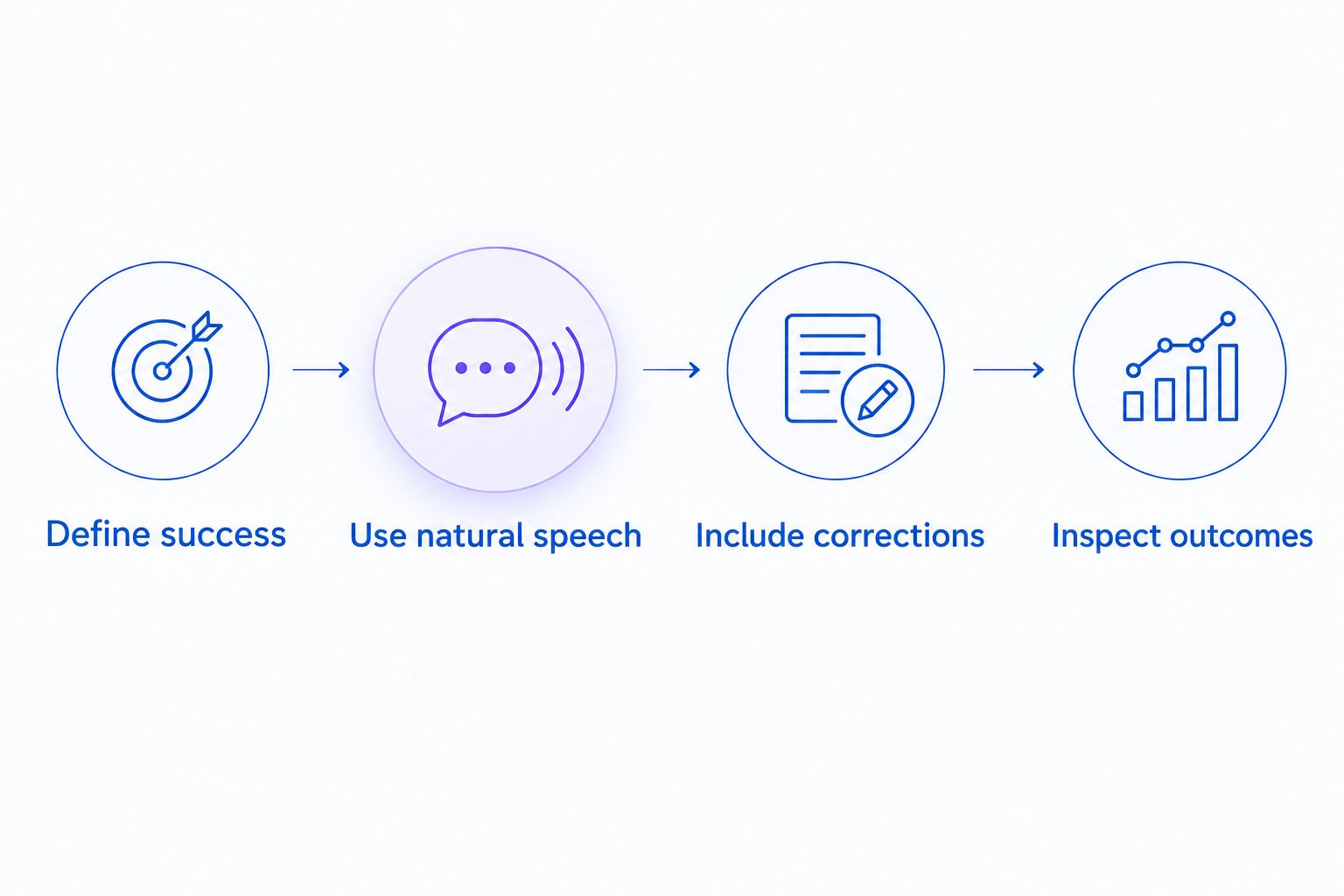
Judge accent handling by the verified outcome, not just the sound of the conversation.
Which Shopify calls should you include?
Use 3 test scenarios: order tracking, refund requests, and abandoned-cart recovery. These cover information delivery, an action-sensitive request, and an outbound conversation without requiring a different evaluation framework for each.
Order tracking
- Best for checking: Names, references, and delivery terminology
- Successful outcome: The agent identifies the intended order and explains its available status
- Failure to watch for: A fluent answer about the wrong order
Refund request
- Best for checking: Intent, corrections, and authorization boundaries
- Successful outcome: The agent understands the request and follows the permitted process
- Failure to watch for: An action taken without the required confirmation
Abandoned-cart recovery
- Best for checking: Outbound comprehension and next steps
- Successful outcome: The agent understands the question and gives an appropriate response
- Failure to watch for: Continuing a sales script after misunderstanding the customer
For order tracking, distinguish available information from promises. The agent should not turn a tracking update into a guaranteed delivery commitment. Accent handling does not remove the need for accurate store data.
For refunds, test a customer who corrects the item under discussion. The important result is whether the corrected item controls the next step. A smooth acknowledgment is insufficient if the action still concerns the original item.
For cart recovery, include a customer question about checkout or an order concern. Review whether the agent answers that question before continuing. Do not use a completed call as a substitute for checking whether the conversation was understood.
Where Avasales fits
Avasales is best for Shopify merchants seeking phone customer support and outbound abandoned-cart recovery in one app. Its stated scope includes answering support calls 24 hours a day, resolving orders and refunds, and making outbound recovery calls.
That scope makes those workflows relevant trial scenarios. It does not establish support for a particular regional accent, an automatic accent-matching feature, or a specific language list. Request a demonstration of the exact speech and workflow your store needs.
Use the 2026 trial evaluation to distinguish setup completion from operational readiness. Setup in minutes gets you started; completed test calls establish whether the configuration meets your acceptance criteria.
Does the agent need to sound like the customer?
No. The agent needs to understand the customer and communicate clearly. A consistent speaking voice is a valid choice even when callers have different regional accents.
Evaluate customer comprehension through the full task, including confirmations. Do not choose a voice solely because its opening sentence sounds familiar.
What should happen when the agent misunderstands an accent?
The agent should ask for the unclear detail again or follow a defined fallback. Require confirmation before an uncertain interpretation leads to an order change or refund action.
Test this behavior deliberately. An evaluation that includes only successful recognition leaves the failure path unexamined.
Can one successful demo prove accent coverage?
No. One successful demonstration proves only that the demonstrated conversation worked. It does not establish performance across different speakers, requests, and call conditions.
Keep your conclusion as narrow as the evidence. Approve the workflows you tested and identify what still needs verification before expanding their use.
FAQ
Can an AI phone agent understand customers with regional accents?
Yes, AI phone agents can understand regional accents, but coverage must be verified for the specific system and workflow. Test natural speech, order details, corrections, and the resulting action.
Does a local speaking voice mean the agent understands that accent?
No. The outgoing speaking voice and incoming speech recognition are separate capabilities. A voice sample demonstrates sound, not understanding.
Can I make the agent automatically copy every caller’s accent?
Do not assume automatic accent matching is available. Ask the provider to demonstrate that specific behavior, and prioritize clear communication over imitation.
Is multilingual support the same as local-accent support?
No. Multilingual support concerns different languages, while accent support concerns pronunciation. Verify each required language separately from regional voice choices.
How should I test accent handling before launch?
Test complete calls with natural speech, corrections, and known expected outcomes. Inspect the resulting order information or action rather than judging only the conversation’s fluency.
Does Avasales have a free trial for Shopify merchants?
Avasales offers a 7-day free trial, setup in minutes, and zero commission on recovered revenue. Use the trial to verify the specific accents and Shopify workflows your store needs.
One last thing
Make one test deliberately ambiguous. Give the agent an unclear detail and check whether it stops to confirm before proceeding. That reveals something a polished voice sample cannot: whether the workflow protects the customer when understanding breaks down.
For your 2026 launch decision, approve accurate task completion and safe clarification separately. Both belong in the acceptance criteria.