Can an AI phone agent handle returns on buy now pay later orders?
AI phone agent BNPL returns need verified orders, approved actions, and clear payment limits. Learn what to automate and when to escalate customer calls.
November 17, 2026

Yes, an AI phone agent can handle buy now pay later return requests when it has verified order access, your return rules, and permission to perform the required actions. It must distinguish a merchant refund from an updated installment schedule and never promise that a return request automatically stops payments.
TL;DR
- AI phone agent BNPL returns require separate checks for return eligibility, refund status, and installment status.
- Shopify refund confirmation does not establish that a customer's payment schedule has changed.
- Avasales offers Shopify phone support; validate provider-specific refund permissions before automating BNPL actions.
- Escalate disputed balances, conflicting records, and requests to change a lender's payment terms.
For Shopify phone support, Avasales offers a 7-day free trial, setup in minutes, and zero commission on recovered revenue. Use that trial to test return conversations against your actual policies before authorizing financial actions.
Can an AI phone agent handle returns on buy now pay later orders?
Yes, but handling the conversation and controlling the financing agreement are different responsibilities. Your agent should complete only the steps that its connected systems and permissions support.
Use these five checks for your 2026 deployment:
- Verify identity. Follow your store's approved verification process before revealing order details or changing an order.
- Confirm the order. Match the requested items to the correct purchase and payment method.
- Check eligibility. Apply your return policy, including any inspection or approval requirement.
- Confirm authority. Establish whether the agent can submit a return, issue an approved refund, or only collect a request.
- Report the actual status. Separate the return request, merchant refund, and provider-side payment update in the closing explanation.
A caller asking to return an item has not necessarily received return approval. Likewise, an approved return does not establish that a refund has been issued. Build those distinctions into the workflow rather than leaving the agent to infer them from conversational context.
Why this matters
A BNPL return involves the customer's purchase and a separate payment arrangement. Your support team needs to explain what the store has done without speaking for a financing provider whose records the team cannot verify.
The critical boundary is simple: report the status your system confirms, not the financial outcome the customer expects. If the store shows a submitted refund but cannot see the updated installment schedule, the agent should explain the merchant action and direct schedule questions to the provider.
For your 2026 support policy, define what counts as a completed call. Collecting a request, approving a return, and confirming a refund are different outcomes. Recording them separately prevents a conversation from being marked resolved while an essential financial question remains unanswered.
Which parts of a BNPL return should you automate?
Choose an automation level based on access and authority, not how natural the voice sounds. Each approach has a useful role and a clear limitation.
Intake only
- Best for: Stores keeping return decisions with staff
- Benefit: Captures the order, item, reason, and requested outcome
- Limitation: Does not approve the return or resolve the payment question
Status support
- Best for: Stores with readable order and return records
- Benefit: Explains confirmed progress without changing money
- Limitation: Cannot fix an incorrect refund or provider balance
Approved actions
- Best for: Stores with tested permissions and explicit rules
- Benefit: Completes permitted return or refund steps
- Limitation: Requires safeguards against unauthorized or duplicate actions
Human escalation
- Best for: Exceptions, disputes, and conflicting records
- Benefit: Routes judgment calls to an accountable person
- Limitation: Needs a clear owner and enough context to avoid repetition
Start with the narrowest scope that answers the customer's question accurately. Expand permissions only after testing the relevant action, failure response, and handoff.
An intake-only agent should describe a request as submitted for review. A status-support agent should name the recorded status. An action-enabled agent should report success only after receiving confirmation from the system responsible for the action.
Intake and return eligibility
The phone agent should establish which item the customer wants to return and why. It should then apply your published policy or collect the information a reviewer needs.
Do not let the agent create an exception because the customer mentions an upcoming installment. Financial urgency does not itself establish return eligibility. Give the agent an escalation route for exceptions rather than permission to invent policy.
Refund execution and confirmation
Before allowing a refund action, define its prerequisites. These should include verified identity, the correct order, an eligible item, required approval, and a check for an existing refund.
The agent should distinguish an attempted action from a confirmed action. If the request times out or returns an ambiguous result, require a status check before another attempt. Repeating an uncertain financial action is not an acceptable recovery method.
Installment questions and disputes
Questions about remaining payments require provider-specific information. Without verified access to that information, the agent should not calculate a replacement schedule or announce that a payment is canceled.
A disputed balance needs a documented handoff. Capture the merchant refund reference when available, the customer's stated concern, and the unresolved question. Do not ask the customer to disclose account passwords or authentication codes.
Why AI phone agent BNPL returns vary
The appropriate workflow depends on the store's rules and the systems involved. Review these factors before enabling actions in 2026:
- Return policy: Eligibility, exclusions, condition requirements, and approval rules determine what the agent can authorize.
- Payment provider: The provider's documented refund process determines how merchant refunds relate to the customer's financing account.
- System access: Reading an order does not establish permission to create a return or issue a refund.
- Return scope: A partial return requires the agent to identify the specific items and avoid describing the entire purchase as refunded.
- Record consistency: Conflicting order, return, and payment records require investigation rather than a confident summary.
- Exception ownership: Your team needs a named destination for disputed balances, policy exceptions, and failed actions.
These are configuration requirements, not reasons to give the agent broader discretion. Write down the permitted action and the stop condition for each branch.
How should the return call move through your systems?
Use a sequence that separates the customer's request from the financial result. The following labels describe a recommended workflow, not a claim that every phone app supports every action.
- Verify caller: Complete your approved identity checks.
- Review order: Confirm the items, payment method, and existing return or refund activity.
- Apply policy: Decide whether the request qualifies or needs review.
- Confirm action: Check that the authorized operation actually succeeded.
- Explain status: State what changed and who owns any remaining question.
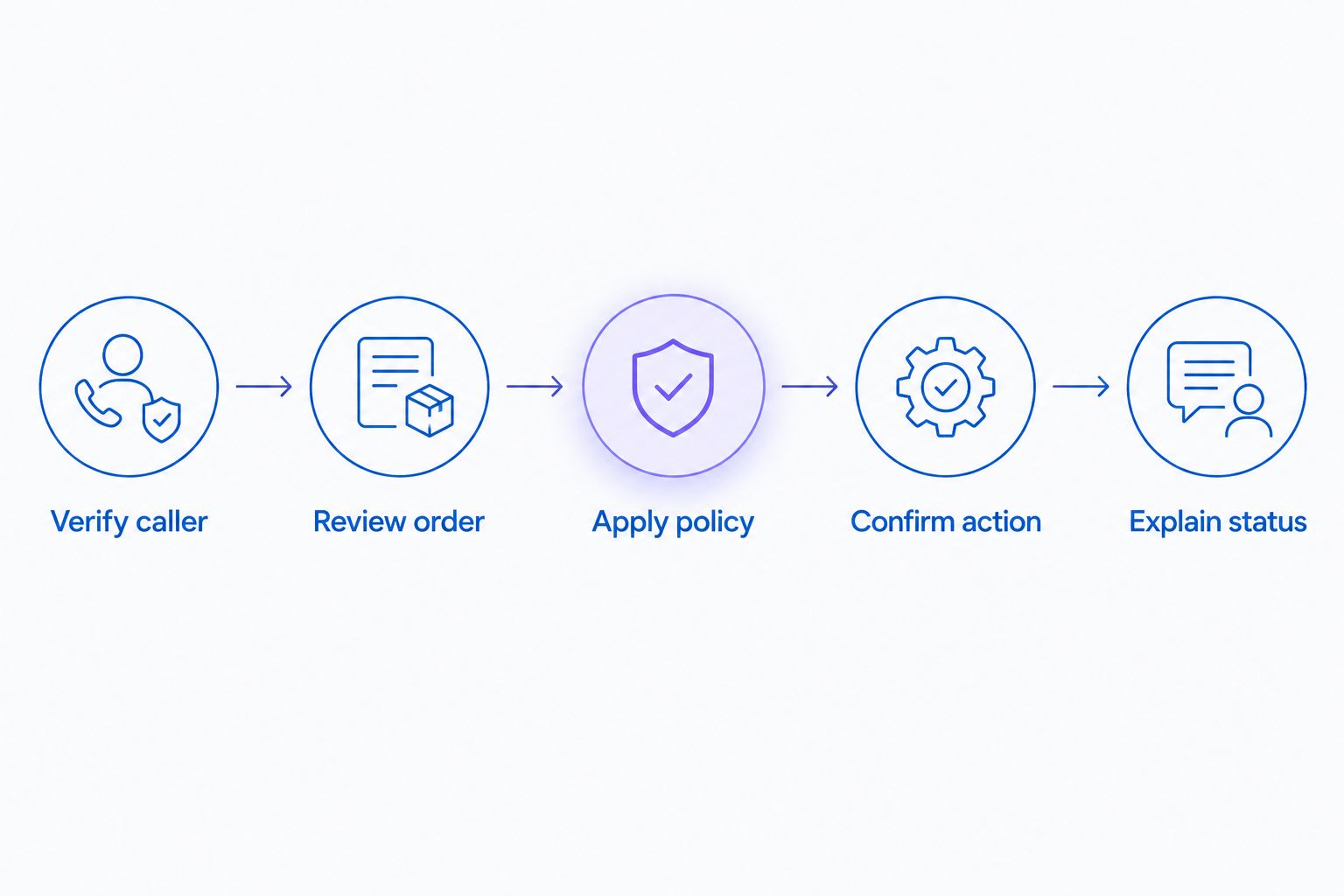
Confirm the action before explaining the financial status.
Keep the refund record available to the person handling the next interaction. A call summary should identify the requested item, the action taken, the confirmation received, and the unresolved issue. Avoid copying unnecessary personal or financial information into free-text notes.
For the merchant-side sequence, the Shopify refunds to automated phone calls workflow addresses the connection between refund activity and customer communication. Treat any provider-side installment update as a separate confirmation requirement.
How do you reconcile the refund with the payment account?
A store refund record and a customer financing balance answer different questions. The former describes the merchant action; the latter describes the customer's account with the payment provider. Your phone script should identify which record supports each statement.
That distinction also applies when integrating AI with finance software: access to an order record is not permission to alter a financing agreement. Set read and write permissions around specific tasks, and require confirmation from the system that owns the financial action.
For a 2026 reconciliation procedure, assign an owner to investigate mismatches. The phone agent should pass along the verified order reference and merchant refund status, then identify what remains unresolved. It should not announce that the provider made an error based only on the customer's description.
Partial returns deserve particular attention. If the customer returns one item from a larger purchase, the agent should describe the confirmed item-level action without guessing how the provider will allocate the adjustment across installments.
Store credit needs a separate explanation too. Do not describe store credit as proof that the original financing balance has been reduced. Confirm the customer's requested outcome before applying an alternative remedy your policy permits.
What should you test before enabling live refund actions?
Test the decision boundaries, not just the greeting. A successful demonstration of a straightforward return does not establish that the agent handles an ambiguous refund safely.
Include these scenarios in your 2026 acceptance checklist:
- Existing refund: The customer asks again after a refund is already recorded. The agent must check status rather than repeat the action.
- Partial return: The customer returns a selected item. The agent must preserve the distinction between that item and the full order.
- Unverified caller: The caller cannot complete verification. The agent must follow the approved recovery or escalation path.
- Uncertain response: A financial action receives no clear confirmation. The agent must investigate status before retrying.
- Payment disagreement: The customer reports an installment after a merchant refund. The agent must separate confirmed facts from the unresolved provider question.
Write an expected result for each test. Require accurate action records and an understandable closing explanation before enabling that branch for customers.
Where does Avasales fit for Shopify merchants?
Avasales is best for Shopify merchants seeking phone support and abandoned-cart recovery in one app. Its stated offering includes answering customer support calls 24/7, resolving orders and refunds, and making outbound calls to recover abandoned carts.
For BNPL returns, evaluate Avasales phone support against the workflow above. Test the specific provider, refund action, available records, and escalation process before authorizing automated financial changes. General Shopify refund support does not establish control over every financing agreement.
Use the 7-day free trial to review conversation accuracy and action boundaries. Setup in minutes is a starting point; provider-specific acceptance testing remains a separate task.
Can the agent tell a customer to stop paying installments?
The agent should not tell a customer to stop paying based solely on a return request or merchant refund status. It should direct the customer to the provider's current account information and instructions for payment obligations.
Can the agent handle a partial BNPL return?
The agent can handle a partial return when its permissions and connected workflow support the specific item-level action. It should report the confirmed merchant refund without inventing a revised installment schedule.
Should every BNPL return go to a human?
Routine intake and verified status questions do not require the same authority as disputed financial changes. Reserve human review for exceptions, conflicting records, failed actions, and decisions outside the agent's approved scope.
FAQ
Can an AI phone agent approve a buy now pay later return?
An AI phone agent can approve a BNPL return only when your policy, system permissions, and required checks authorize that decision. Otherwise, it should collect the request for review.
Does returning an item automatically stop BNPL payments?
A return request alone does not establish that BNPL payments have stopped. The customer should follow the provider's current account information and instructions.
Can an AI phone agent issue a BNPL refund through Shopify?
An AI phone agent can issue a permitted refund only when the connected Shopify workflow supports the action and its prerequisites are satisfied. Provider-side installment changes need their own confirmation.
What happens if the customer already received a refund?
The agent should verify the existing refund and avoid submitting another one. If the customer disputes the payment account balance, record the merchant confirmation and escalate the unresolved question.
Can the agent promise when the BNPL refund will appear?
The agent should state a refund timeline only when a current, applicable source supports it. It should not invent a deadline from the date of the return request.
Is store credit the same as refunding a BNPL purchase?
Store credit is not confirmation that the original BNPL balance has been adjusted. The agent should explain the remedy accurately and confirm the customer's choice under your policy.
Can a phone agent handle BNPL return calls outside business hours?
A phone agent can collect requests and explain accessible, verified records outside business hours. Actions requiring staff approval must remain pending until an authorized person reviews them.
One last thing
Require the closing explanation to name both the completed action and the unresolved question. A return call is not financially resolved merely because the conversation ended politely. Your customer should leave knowing what the store confirmed and who handles the next step.