Can an AI phone agent handle subscription cancellation calls?
AI phone agent subscription cancellation calls work with verified access. Learn what to test, when to use human help, and how to confirm completion.
November 13, 2026

Yes, an AI phone agent can handle subscription cancellation calls when it can verify the caller, access the subscription system, and perform the authorized cancellation action. Taking a request is not the same as stopping future renewals. For your 2026 rollout, require confirmation from the subscription system before the agent tells a customer the cancellation is complete.
TL;DR
- AI phone agent subscription cancellation calls require identity verification, authorized subscription access, and confirmed changes.
- Avasales is best for Shopify merchants seeking phone support and abandoned-cart recovery; verify subscription-specific actions before deployment.
- Canceling a subscription, canceling an order, and issuing a refund are separate actions.
- Route disputed charges, failed verification, and unsuccessful subscription changes to a human.
Start with the Avasales 7-day free trial, setup in minutes, and zero commission on recovered revenue. Its Shopify phone support runs 24 hours a day, 7 days a week; evaluate subscription cancellation separately from its order support and abandoned-cart recovery functions.
Can an AI phone agent handle subscription cancellation calls?
Yes, provided the agent can complete the subscription change, not just discuss it. Your acceptance test should follow the request from the phone conversation to the subscription record. A polite goodbye does not establish that recurring billing has stopped.
Decide which operating model you want before evaluating an agent. Each model below serves a different purpose, and each needs an explicit customer-facing description of what happened.
Request intake
- Best for: Collecting cancellation requests for staff
- Benefit: Captures the customer's intent without granting billing-change authority
- Limitation: Does not itself stop renewals
Authorized cancellation
- Best for: Routine requests within defined store policies
- Benefit: Can complete the request when the connected system supports the action
- Limitation: Requires verified identity, permissions, and confirmation
Human handling
- Best for: Disputes, exceptions, or unclear account ownership
- Benefit: Gives staff control over decisions outside the automated workflow
- Limitation: Requires staff availability or a clearly owned follow-up
Do not describe request intake as automated cancellation. If a human still needs to act, tell the customer that the request is awaiting completion and identify the next step.
Why this matters
Subscription cancellation touches future billing, existing orders, and customer expectations. Those are related records, not interchangeable instructions. A customer asking to stop future deliveries has not necessarily asked you to refund a previous purchase.
Your 2026 evaluation should therefore prioritize the recorded outcome over the agent's conversational style. Ask whether the correct subscription changed, whether an existing order stayed untouched, and whether the customer received an accurate explanation. Those checks test the task you actually need done.
Treat retention as optional. A cancellation workflow should still complete correctly when the customer declines every alternative you offer.
Request intake: capture intent without claiming completion
Use request intake when you want the phone agent to collect details but reserve subscription changes for staff. The agent should identify the customer, establish which subscription is involved, and record whether the request concerns future renewals or an existing order.
Best for: merchants keeping subscription changes under human control. This model limits the agent's authority while giving your team a structured request to review. Its limitation is equally clear: the subscription remains unchanged until someone completes the action.
Write the closing instructions accordingly. Tell the customer what was recorded, who owns the next step, and how completion will be communicated. Do not let an acknowledgment sound like a cancellation receipt.
Authorized cancellation: confirm the change before closing
Use authorized cancellation only after testing the exact subscription action your store needs. Reading account details and changing renewal status require different permissions. Successful access to Shopify order information does not prove that the agent can update a separate subscription record.
Best for: routine cancellation requests with clear account ownership and policies. The benefit is completion during the supported workflow. The limitation is dependence on the connected system, the permissions granted, and the action's returned result.
Your 2026 acceptance criteria should include a failed action as well as a successful one. When the subscription system rejects a request or returns an unclear result, require the agent to report that uncertainty accurately and assign follow-up.
Human handling: retain control over exceptions
Keep disputed charges, unclear identity, contradictory account records, and requests outside policy with a human. The agent's role in these cases should be to preserve the request and explain what happens next, not to improvise a billing decision.
Best for: exceptions requiring judgment or additional authority. Human handling gives your team responsibility for the decision, but the handoff needs an owner. A request that sits unassigned is not a completed service interaction.
Include the requested action, verification status, relevant subscription, and any attempted changes in the handoff. Staff should be able to distinguish a pending request from a failed cancellation without asking the customer to reconstruct the call.
How should an automated cancellation call work?
Build your workflow around these steps. Treat them as requirements to test in your own environment, not as assumed features of every phone agent.
- Verify identity. Apply your approved account-verification procedure before revealing subscription details or changing billing instructions. If verification fails, stop the account action and explain the approved route to assistance.
- Find subscription. Identify the specific recurring arrangement the customer wants to cancel. When an account has several subscriptions, clarify the intended selection instead of changing all of them.
- Confirm intent. Establish whether the customer wants to stop future renewals, cancel an existing order, request a refund, or pursue more than one action. Read back the intended scope before making changes.
- Apply change. Submit only the authorized action to the subscription system. Do not substitute a pause, skip, or other alternative without the customer's explicit agreement.
- Verify result. Check the returned status and the resulting subscription record. If completion cannot be established, keep the request open for follow-up rather than declaring success.
- Confirm outcome. Explain what changed, what remains unchanged, and whether any separate order or refund request still needs attention. Record the outcome for your support team.
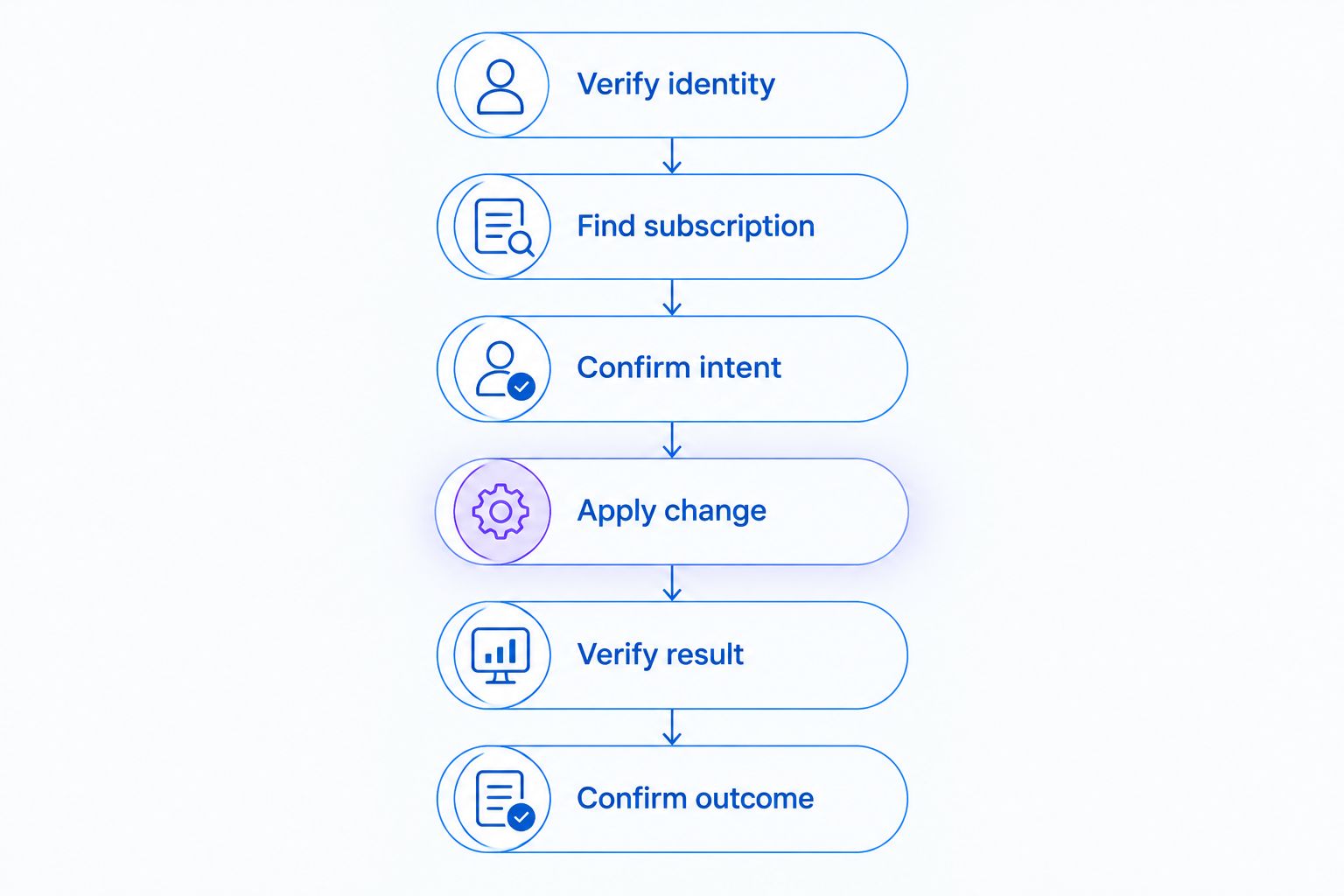
The agent should verify the subscription change before confirming cancellation to the customer.
For verification planning, use the guide to identity checks before issuing a refund as a related account-security topic. Define the permissions for subscription changes separately; authority to handle a refund does not establish authority to stop a renewal.
Why subscription cancellation handling varies
The deciding factors are the workflow's permissions and evidence of completion. Use these requirements when comparing implementations rather than assuming a natural-sounding conversation proves operational readiness.
- Subscription access: Confirm that the integration reaches the system holding the recurring agreement, not merely the customer's purchase history.
- Action permissions: Specify which changes the agent can make and which require staff approval. Keep access aligned with the assigned task.
- Identity rules: Define how callers establish authority over the account and what happens when verification fails.
- Order status: Separate future renewals from orders already created. Give each requested change its own outcome.
- Policy exceptions: Identify cases the automated workflow must not decide, including disputes or requests requiring discretionary approval.
- Failure handling: Assign ownership when an action times out, returns an error, or produces an ambiguous result. Require a status check before another attempt.
Document these requirements for your 2026 launch. Configuration changes should trigger another review of the affected workflow, especially when permissions or subscription policies change.
Can the agent offer a pause instead of cancellation?
Yes, if your subscription system supports pausing and your policy permits the offer. Present it as an optional alternative, explain its effect, and proceed with cancellation if the customer declines.
Do not interpret silence, frustration, or an unfinished answer as agreement to continue the subscription. Your test should include a customer who interrupts the offer and repeats the cancellation request. The workflow must preserve that intent.
If you include alternatives in your script, test each path through to the account record. The record should match the choice the customer actually made, not the outcome your retention team preferred.
Does canceling a subscription also cancel an existing order?
No, stopping future renewals and canceling an existing order are separate instructions. Treat an existing order as unchanged unless its cancellation is separately authorized and confirmed.
Ask which outcome the customer wants when the request is ambiguous. A customer concerned about the next delivery needs an explanation grounded in the subscription and order records, not a general promise that everything has been canceled.
Record each result separately. A subscription cancellation can be complete while an order cancellation or refund request still awaits review.
How should you test cancellation calls before launch?
Test the workflow against the account records, not only the call transcript. Prepare controlled scenarios with known starting states and check the resulting subscription, order, and support records after each call.
Include straightforward cancellation, multiple subscriptions, failed identity verification, a declined retention offer, an existing order, and a subscription-system error. Also test a caller who changes their mind before authorizing the action. These scenarios expose different decision points without requiring invented performance benchmarks.
For each test, record the intended action, the action attempted, the system response, and the final account state. Review the customer's closing explanation alongside those records. A successful test requires an accurate account outcome and an accurate explanation of that outcome.
Where does Avasales fit for Shopify merchants?
Avasales is best for Shopify merchants seeking phone-based customer support and abandoned-cart recovery. Its stated functions include answering support calls around the clock, resolving orders and refunds, and making outbound cart-recovery calls.
For subscription cancellation, verify the specific integration, permissions, and confirmation workflow before assigning live requests. General support coverage is useful, but your deployment decision should rest on demonstrated subscription actions. Keep cancellation results separate from recovered-cart revenue when assessing the trial.
Use the 7-day trial to test the relevant customer journeys. Setup in minutes describes getting started; your cancellation acceptance checks still need to establish that the subscription workflow behaves as intended.
Confirm your cancellation workflow
Discuss subscription access, cancellation permissions, and exception handling for your Shopify store.
FAQ
Can an AI phone agent cancel a subscription without a person?
Yes, when the agent has authorized access to perform the cancellation and can verify the resulting subscription status. A workflow that only records the request still requires someone else to complete it.
What should I check before automating cancellation calls in 2026?
Check identity verification, subscription-system permissions, action confirmation, and exception handling before automating cancellation calls in 2026. Test unsuccessful actions as carefully as successful ones.
Can a phone agent cancel a subscription using only order history?
Order history alone does not establish permission or capability to cancel a subscription. Verify access to the system that controls future renewals and test the actual cancellation action.
Will canceling my subscription automatically refund my last order?
A subscription cancellation should not be treated as confirmation of a refund. Ask for the refund separately and confirm its outcome under the store's applicable policy.
What happens if the cancellation system fails during the call?
The agent should explain that completion has not been confirmed and route the request for follow-up. Check the subscription status before retrying an action with an unclear result.
Should an AI phone agent keep offering alternatives after I say cancel?
The cancellation workflow should respect a clear cancellation request. Any pause or retention alternative should remain optional and require explicit agreement.
Is Avasales suitable for Shopify subscription cancellation calls?
Avasales provides Shopify phone support and abandoned-cart recovery. Verify the subscription integration, permitted cancellation actions, and completion checks before using it for subscription cancellation calls.
One last thing
Test the closing sentence as carefully as the cancellation action. If the agent says the subscription is canceled while the record only shows a request, the call has produced a misleading outcome.
Before your 2026 launch, require the customer-facing explanation to match the verified account state. That is the most useful rule for deciding when an automated cancellation call is truly complete.