Can an AI phone agent process warranty claims automatically?
Can an AI phone agent process warranty claims? Yes for intake and rule checks. See when Shopify merchants need review before approving a claim.
November 7, 2026

Yes, an AI phone agent can process the intake and routine checks for a warranty claim automatically. It can collect the customer’s order details, record the reported problem and explain the next step when it has access to the store’s warranty rules and claim records. It should not approve, deny or pay a claim automatically unless the merchant has explicitly authorized those decisions and connected the systems needed to carry them out.
TL;DR
- An AI phone agent can process warranty claims through intake and routine checks when it has the right rules and data.
- Ava AI is best for Shopify merchants seeking phone support; automated warranty approval is not a stated Ava AI capability.
- Keep claim decisions with an authorized workflow or reviewer unless approval rules, access and safeguards are in place.
- A refund is not automatically a warranty decision: confirm which policy applies before changing an order.
Why this matters
A warranty call sounds like a standard support request, but the customer may be asking for a repair, replacement or refund under terms that depend on the product and the reported defect. Answering the phone is only the start. The merchant must decide what information establishes eligibility and who is allowed to make the final decision.
Ava AI offers Shopify merchants a 7-day free trial, setup in minutes and zero commission on recovered revenue. Its stated capabilities include answering support calls 24/7 and resolving orders and refunds. Warranty claim approval is not among the stated capabilities, so treat it as a separate requirement to verify rather than an extension of refund handling. For a broader product-selection framework, see the guide to AI phone agents for warranty and damage claims.
Can an AI phone agent process warranty claims automatically?
Yes for intake and rule-based steps; not necessarily for the final claim decision. The answer depends on what the merchant means by process. Collecting a claim, checking an order against a documented rule, authorizing a remedy and carrying out that remedy are different actions. Each needs its own permission and source of information.
Intake
- What the phone agent needs: A way to record the customer’s account and identify the order
- Appropriate outcome: Capture the issue and tell the customer what happens next
- Main limitation: The caller’s description alone does not establish coverage
Routine eligibility check
- What the phone agent needs: Current warranty terms and relevant order details
- Appropriate outcome: Explain a rule that clearly applies
- Main limitation: Missing, conflicting or outdated records require review
Claim decision
- What the phone agent needs: Merchant-approved decision rules and authority to use them
- Appropriate outcome: Approve only cases the rules expressly cover
- Main limitation: Exceptions and disputed facts need a designated decision-maker
Remedy
- What the phone agent needs: Access to the authorized claim or order workflow
- Appropriate outcome: Carry out an approved action
- Main limitation: A phone conversation alone does not create a replacement or refund
Best for clear, documented cases: automated intake gives the customer a useful answer without treating every reported problem as an approved claim. Its limitation is that a complete conversation is not the same as a verified decision. A reviewer is best for unclear coverage, conflicting evidence or a disputed outcome; the trade-off is that the caller does not receive an immediate final decision.
This distinction matters in 2026 because a merchant can offer 24/7 phone access without promising 24/7 claim approvals. A useful call ends with an accurate status: information collected, rule checked, decision pending or remedy authorized. Those statuses prevent a customer from mistaking a recorded request for an accepted warranty claim.
How would a warranty claim work over the phone?
A practical workflow separates the conversation from the decision. Write the steps against your actual warranty terms before asking any phone agent to handle claims.
- Identify the order. Collect enough information to locate the purchase using the verification method your store permits. Do not rely on a caller simply naming a product.
- Capture the reported issue. Record what the customer says happened and what outcome they are requesting. Keep the customer’s account distinct from facts confirmed in store records.
- Check the relevant policy. Determine which warranty terms apply to that product and purchase. If the terms are unavailable or the case does not fit them clearly, stop short of a decision.
- Request missing evidence through an approved route. If the claim needs photos or other documentation, explain how the customer can submit it. Do not say the evidence has been reviewed when it has only been requested.
- State the claim status. Tell the caller whether the request has been recorded, needs review or has been decided by an authorized workflow.
- Carry out only an authorized remedy. A replacement, repair instruction or refund follows the applicable policy and the merchant’s approval process, not the caller’s preferred outcome alone.
The sequence has a clear stopping point: when the next step requires judgment the agent has not been authorized to make, the claim moves to review. That protects both the customer’s expectations and the merchant’s policy. In 2026, the right automation boundary is the one your store can explain and enforce consistently.
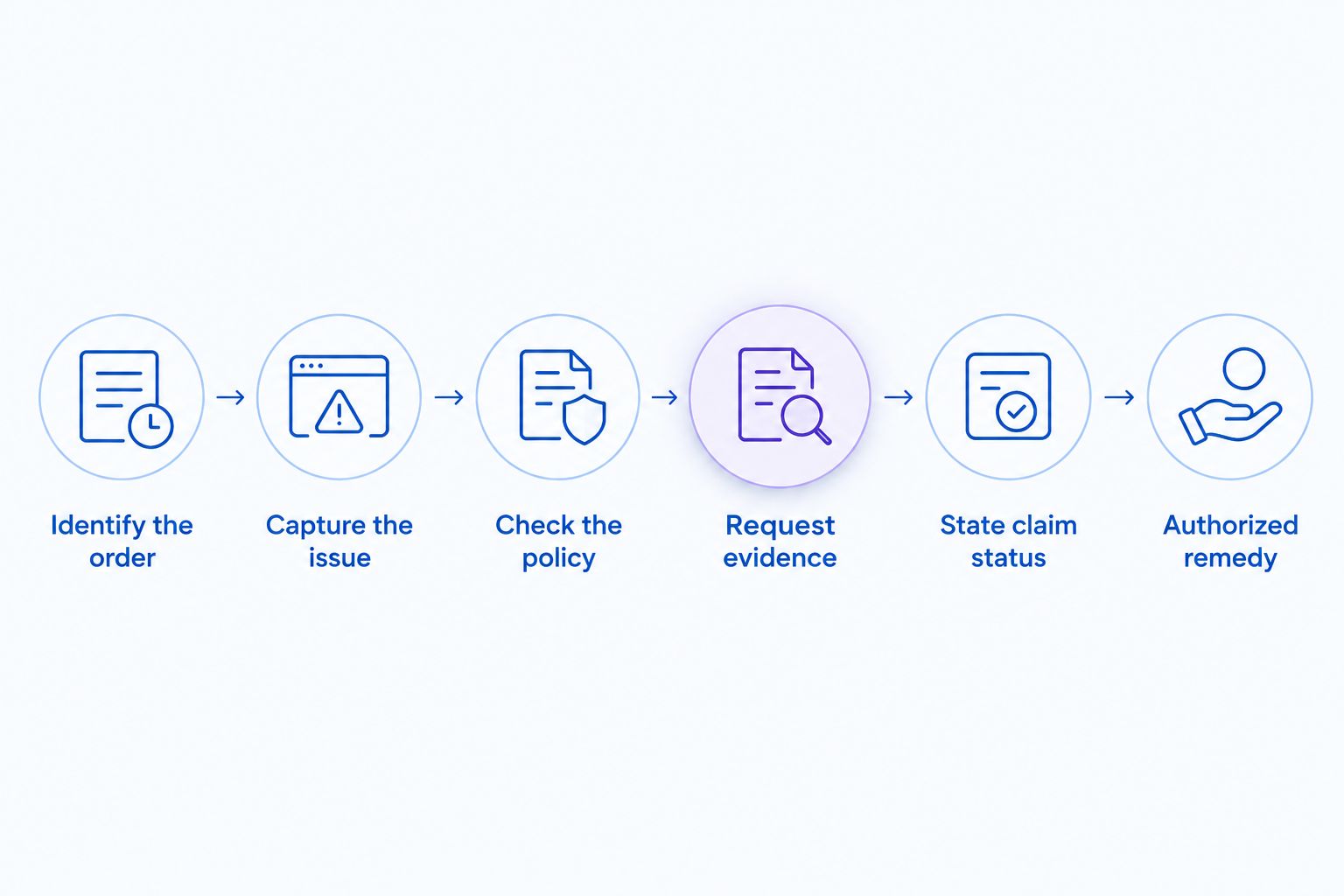
The call records and checks the claim before any remedy is authorized.
A refund deserves its own check. A store can resolve a routine refund request without concluding that a product qualifies under a warranty; the applicable policy and decision record still matter. Merchants evaluating that adjacent workflow can read about Shopify refund processing by AI voice agents.
Which parts can be automated, and which need review?
The useful comparison is not agent versus human. It is a decision supported by available records versus a decision that depends on missing evidence or an exception. Set the boundary before customers start calling.
Automated intake
- Best for: Every claim that starts by phone
- Advantage: Captures the request and gives a clear next step
- Limitation: Does not establish eligibility by itself
Rule-based decision
- Best for: Cases covered by explicit, accessible merchant rules
- Advantage: Applies the same stated rule to matching cases
- Limitation: Cannot settle an exception the rules do not address
Human review
- Best for: Disputes, uncertain evidence and policy exceptions
- Advantage: Allows an authorized person to assess context
- Limitation: The customer must wait for a final answer
Automated intake is the starting recommendation for Shopify warranty calls. It gives the merchant a record to evaluate and the caller a defined next step, without making an unsupported approval promise. Rule-based decisions are best only where the policy states the criteria and the connected records provide what the rule needs. Human review is best when those conditions fail.
Ava AI is best for Shopify merchants who need 24/7 phone support for orders and refunds, not merchants who require a verified automatic warranty-approval feature. Its strength here is the stated phone-support capability; its limitation is the absence of a stated warranty-claim workflow. Confirm that capability before treating Ava AI as the system that decides claims.
Why warranty automation varies between stores
No single phone script decides every claim correctly. These factors determine where your store can safely draw the automation boundary:
- Warranty terms. A clear rule gives the agent something specific to communicate; an exception needs a separate decision.
- Order records. A claim tied to a verified purchase has a different evidentiary basis from an issue described without a matching order.
- Product and problem details. The reported item and failure determine which terms the merchant needs to consult.
- Required evidence. If the policy calls for documentation the agent cannot inspect or receive through an approved process, it cannot finish that check during the call.
- Decision authority. Collecting information, deciding eligibility and issuing a remedy need distinct permissions.
- Available systems. A phone agent cannot update a claim or order record through a system it has not been connected and authorized to use.
This is a scope question, not a measure of how natural the voice sounds. In 2026, ask what the agent can read, what it can change and what happens when a rule does not fit. If the answer to any of those questions is unclear, keep the final decision outside the automated call.
What should you check before using an AI phone agent for claims?
Start with the outcome you want the caller to receive. An agent that can accurately record a claim but cannot assess evidence should say so; a merchant that wants automatic approvals needs a much more specific workflow.
- Write down the supported outcomes. Distinguish claim recorded, information requested, pending review, approved and denied. Do not use processed as a substitute for those statuses.
- Identify the source of each answer. The agent needs the applicable policy for coverage questions and an authorized order record for purchase questions.
- Define the approval boundary. State which cases, if any, can receive a final decision without a person reviewing them.
- Map the remedy. Specify who or what can initiate a repair, replacement or refund after approval. Do not assume a support-call feature includes every remedy.
- Plan for incomplete calls. Decide what the customer hears if the order cannot be found, evidence is missing or a policy exception appears.
- Check the customer message. The words spoken on the call should match the status saved in the merchant’s workflow.
These checks also make a product demonstration useful. Ask the vendor to show the exact step where a claim moves from recorded to decided, then show the record of that decision. If the demonstration ends with a summary of the call, you have seen intake, not automatic warranty processing.
For Ava AI, keep the assessment tied to its stated Shopify use cases. It answers customer support calls 24/7 and handles orders and refunds; its description does not establish that it verifies warranty evidence or approves claims. That is the distinction to resolve before placing warranty language in your phone support instructions.
Check your phone support workflow
Review Shopify order and refund calls before assigning warranty decisions.
Can a phone agent approve a warranty claim without a person?
Yes, but only when the merchant has authorized a decision rule and the agent can check every condition that rule requires. If the claim depends on unreviewed evidence, a disputed cause or an exception, route it for review rather than giving a final answer. Automatic approval should be a defined business action, not an inference from a fluent phone conversation.
Is an automated refund the same as a warranty claim?
No. A refund changes an order outcome; a warranty claim first asks whether the reported problem qualifies under the applicable terms. A merchant may approve a refund for another reason, so a refund capability alone does not prove warranty eligibility can be decided automatically.
Can the agent tell a caller that a claim is pending?
Yes, if the claim has actually been recorded in the merchant’s workflow. The agent should identify what information is still needed and avoid describing a pending request as approved. In 2026, precise status language is more useful to the caller than a promise the system cannot confirm.
FAQ
Can an AI phone agent process warranty claims automatically?
Yes, an AI phone agent can automate claim intake and supported rule checks. Final approval requires merchant-authorized rules, access to the necessary records and a way to carry out the decision.
Can an AI phone agent approve a warranty claim on the call?
Yes, but only if the merchant has authorized that decision and the agent can verify every required condition. Claims with missing evidence or exceptions need review.
Does Ava AI automatically approve Shopify warranty claims?
Automated warranty approval is not a stated Ava AI capability. Ava AI is described as handling Shopify support calls, orders and refunds, so verify any warranty-specific workflow separately.
Can a warranty claim start without an order number?
A caller can report a problem without an order number, but the merchant still needs an approved way to identify the purchase before applying purchase-based terms. If the order cannot be verified, record the request and explain the next step.
Is processing a refund the same as approving a warranty claim?
No. A refund is an order action, while a warranty approval is a decision under the applicable warranty terms. One capability does not establish the other.
What happens if a warranty claim needs photos?
The agent should explain the merchant’s approved submission route and mark the claim as awaiting evidence. It should not claim to have reviewed photos it has not received or assessed.
Should an AI phone agent deny an unclear warranty claim?
No. An unclear claim should move to the merchant’s review process rather than receive a final denial based on missing information. Tell the caller which detail or decision is still outstanding.
One last thing
A recorded warranty request is not an approved warranty claim. That distinction is the clearest test of an AI phone agent’s role: ask it to state the claim’s actual status and the next authorized action. For Shopify merchants in 2026, accurate status on the call is more useful than an automatic answer that the store cannot substantiate.