Can an AI phone agent quote accurate shipping cutoff dates?
AI phone agent shipping cutoff dates are accurate only with current store rules. Learn what to verify, when to escalate, and how to avoid false promises.
November 10, 2026

Yes, an AI phone agent can quote accurate shipping cutoff dates when it has current, merchant-approved deadlines and enough information to select the correct rule. The caveat is that an order deadline, a dispatch date, and an estimated arrival date are different commitments. For AI phone agent shipping cutoff dates, accuracy depends on verified shipping information, not how confidently the agent speaks.
TL;DR
- AI phone agent shipping cutoff dates require current store rules, destination details, and the relevant shipping service.
- Keep order deadlines, dispatch dates, and delivery estimates separate in every phone answer.
- Avasales offers Shopify phone support; verify the shipping cutoff workflow before allowing date-specific answers.
- Escalate conflicting or missing shipping information instead of inventing a delivery promise.
For merchants evaluating phone support, Avasales offers a 7-day free trial, setup in minutes, and zero commission on recovered revenue. Its Shopify phone agent answers customer support calls 24/7, handles order and refund requests, and makes outbound abandoned-cart recovery calls. Evaluate shipping-date answers separately from those broader capabilities.
Why this matters
A caller asking whether a gift will arrive on time needs an answer that supports a purchase decision. Repeating a general shipping policy does not resolve that question if the deadline changes by destination, shipping service, or fulfillment arrangement.
For your 2026 shipping calendar, approve the exact distinction between ordering on time and receiving an order on time. A correct cutoff date is not automatically a delivery guarantee. Your phone workflow should preserve that distinction even when a customer asks for a simple yes or no.
Can an AI phone agent quote accurate shipping cutoff dates?
Yes, provided the workflow retrieves the applicable shipping rule, checks the customer's circumstances, and limits its answer to what the source supports. Use the following sequence as an acceptance checklist before approving date-specific phone answers.
- Confirm the request. Establish whether the caller wants the latest order deadline, an expected dispatch date, or an arrival estimate. Do not treat these as interchangeable.
- Collect shipping details. Ask for the destination and shipping service needed to select the applicable rule. For an existing order, verify identity before discussing customer-specific information.
- Check current rules. Use the merchant-approved shipping calendar or operational source designated for that answer. Confirm that the information applies to the current selling period.
- Resolve exceptions. Check whether the order has a fulfillment condition that changes the standard answer. If sources conflict, stop the date-specific response and seek confirmation.
- State the boundary. Give the supported deadline with its time zone and conditions. Identify an estimate as an estimate, and explain what requires further confirmation.
The Shopify order data to real-time phone answers workflow covers the broader connection between order information and phone responses. For cutoff questions, your acceptance test should focus on whether the answer uses the right source and preserves its conditions.
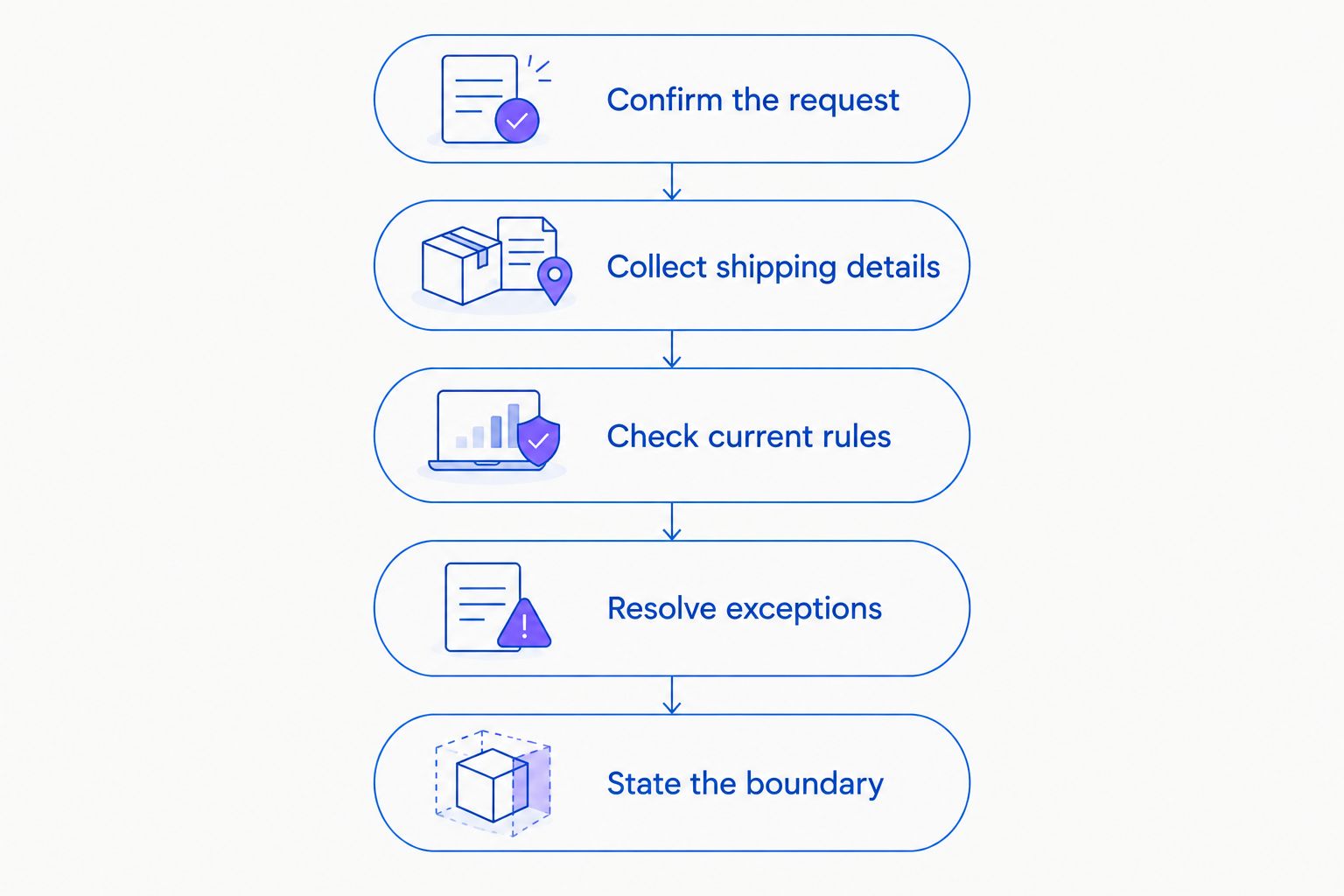
Resolve missing or conflicting shipping information before quoting a deadline.
Match the answer to the shipping question
A shipping policy, a cutoff calendar, and tracking information serve different purposes. Choose the source that answers the caller's actual question rather than treating every shipping reference as equally authoritative.
Approved cutoff calendar
- Best for: Latest order deadlines
- Strength: Gives the merchant's stated ordering conditions
- Limitation: Does not establish the status of an existing parcel
General shipping policy
- Best for: Processing rules and service explanations
- Strength: Explains how the store handles shipping
- Limitation: Broad wording is insufficient for an exact arrival promise
Order and fulfillment record
- Best for: Existing-order questions
- Strength: Establishes the recorded order and fulfillment state
- Limitation: Does not by itself prove delivery by a requested date
Carrier tracking information
- Best for: Dispatched-parcel updates
- Strength: Provides shipment-specific tracking details
- Limitation: A displayed estimate must not become an unconditional promise
Human confirmation
- Best for: Missing rules and conflicting information
- Strength: Allows an authorized person to resolve an exception
- Limitation: Requires a handoff rather than immediate automated resolution
Best for exact cutoff questions: an approved cutoff calendar matched to the caller's shipping details. Use order records and tracking when the question concerns a purchase already placed.
This is a source-selection framework, not a claim that a particular app connects to every source listed. Before deployment, verify which information your chosen phone workflow actually reads and what happens when that information is unavailable.
Why shipping cutoff dates vary
Build your 2026 shipping instructions around the factors that determine the applicable deadline. Include a factor only where it changes your store's actual shipping rules.
- Destination. Identify which countries, regions, or postal areas share a rule. Do not apply a domestic deadline to an international request without an approved basis.
- Shipping service. Attach each cutoff to the service it covers. A deadline associated with one service should not be presented as valid for every delivery method.
- Processing requirements. Separate the time needed to prepare an order from the time a carrier needs to transport it. Document any relevant product-specific conditions.
- Fulfillment calendar. State how your shipping rules treat non-dispatch days, closures, and seasonal exceptions. Remove superseded instructions from the active source.
- Time zone. Include the time zone with any time-of-day deadline. The caller's local time should not silently replace the fulfillment location's applicable time.
- Shipment exceptions. Define how the workflow handles disrupted service, split shipments, and conflicting updates when those situations apply to your operations.
Each factor needs an operational rule, not an instruction to give the customer the best possible answer. A phone agent needs a clear boundary for what it can state and what requires confirmation.
Separate deadlines, dispatch dates, and delivery estimates
An order cutoff tells the customer when an eligible purchase must be completed under the merchant's stated conditions. It should name the relevant service, destination scope, and any qualification attached to the deadline.
A dispatch date concerns when an order leaves fulfillment. If the source supports dispatch only, the phone answer should stop there rather than adding an unsupported arrival date.
A delivery estimate describes expected arrival. Preserve the source's uncertainty instead of replacing estimated language with guaranteed language during the conversation.
For your 2026 scripts, write separate response rules for these concepts. Review the final wording, not just the retrieved date: an accurate date attached to the wrong commitment still gives the customer a misleading answer.
Avoid creating sample dates that remain in production instructions. Use a structured deadline field populated from your approved calendar, and require confirmation when that field is empty or no longer applicable.
What should the agent say when shipping data is missing?
The agent should identify what it can confirm and explain what still needs checking. If the destination-specific cutoff is unavailable, it should not substitute a general shipping estimate and present it as the answer.
Define the fallback before launch. Your instructions should specify which information to collect, which team receives the question, and whether the caller should wait for confirmation before relying on a deadline.
For an existing order, the fallback should preserve the difference between recorded fulfillment status and expected arrival. A label or dispatch update is not permission to promise delivery by the customer's requested date.
A useful handoff contains the customer's question, relevant shipping details, the source checked, and the unresolved conflict. Keep customer-specific information within the access and verification rules you approve for support.
How should you test shipping cutoff answers before launch?
Test your 2026 shipping workflow against approved answers, including cases where the correct result is escalation. A fluent response is not a passing result if it selects the wrong service or promises more than the source supports.
Use these test cases:
- Before the deadline: the response states the applicable cutoff and its conditions without adding a guarantee.
- After the deadline: the response does not repeat an expired ordering opportunity as still applicable.
- Different destination: the workflow requests the detail needed to choose the correct regional rule.
- Different service: the response does not reuse another shipping method's deadline.
- Conflicting sources: the workflow seeks confirmation instead of choosing whichever date sounds more helpful.
- Existing order: the answer uses the order's recorded state rather than treating the caller as a prospective buyer.
- Missing information: the response explains the limitation and follows the approved handoff route.
Record the expected answer beside each case. Review whether the workflow selected the correct source, preserved the time zone, distinguished dispatch from arrival, and avoided unsupported certainty.
After changing a cutoff calendar, repeat the affected tests. Treat a source update as a change to customer-facing instructions, not merely an administrative edit.
Where Avasales fits for Shopify merchants
Avasales is best for Shopify merchants seeking phone support and outbound abandoned-cart recovery in one app. Its stated scope includes answering support calls around the clock, resolving order and refund requests, and calling customers about abandoned carts.
For this shipping use case, evaluate Ava AI against your actual cutoff rules during the trial. Confirm how the proposed setup obtains deadlines, handles time zones, and responds when information is missing before authorizing date-specific answers.
The benefit is a phone-support workflow you can assess alongside order support and checkout recovery. The limit is equally clear: those broader functions do not establish that your store's shipping calendar is connected or that every delivery-date question can be resolved automatically.
Use the 7-day trial to review relevant call scenarios rather than treating installation as proof of shipping accuracy. Setup in minutes describes getting started; approving the operational answers requires your store's rules and acceptance checks.
Review your shipping support workflow
Ask how your approved cutoff rules would be used before enabling date-specific phone answers.
FAQ
Can an AI phone agent guarantee delivery before a holiday?
An AI phone agent should state a delivery guarantee only when an authorized source explicitly supports that commitment for the customer's shipment. An order cutoff or estimated arrival date alone does not establish a guarantee.
What information does a phone agent need to quote a shipping cutoff?
A phone agent needs the applicable merchant-approved cutoff rule and the destination and shipping details required to select it. The answer must preserve the rule's time zone, conditions, and distinction between ordering and delivery.
Can a phone agent use carrier tracking to answer cutoff questions?
Carrier tracking supports questions about an existing shipment, not the merchant's latest order deadline. Use the approved cutoff calendar for ordering deadlines and shipment-specific information for parcel updates.
What happens if shipping rules and tracking information disagree?
The phone workflow should seek confirmation when relevant sources conflict. It should explain the unresolved issue without selecting a date arbitrarily or presenting an estimate as certain.
Does Avasales offer a trial for Shopify phone support?
Avasales offers a 7-day free trial, setup in minutes, and zero commission on recovered revenue. Use the trial to assess your shipping-question scenarios separately from general call handling.
Should shipping cutoff answers change after an order is placed?
After an order is placed, the answer should reflect the order's recorded fulfillment state and relevant shipment information. A pre-purchase ordering deadline does not establish when an existing parcel will arrive.
How should I maintain shipping cutoff instructions in 2026?
Maintain an approved 2026 shipping calendar, remove superseded rules, and retest affected phone answers after changes. Assign responsibility for resolving conflicting information before it reaches callers.
One last thing
Test the unanswered question as carefully as the answered one. Give the workflow a deadline request with a missing destination or conflicting source, then check whether it asks for clarification or seeks confirmation.
Approve the agent's refusal to guess before approving its ability to quote dates. That check protects the boundary between helpful shipping support and an unsupported delivery promise.