Can an AI voice agent handle a customer asking for a price match?
An AI voice agent price match request needs clear rules. Learn what to verify, when to approve adjustments, and when Shopify staff should take over.
November 11, 2026

Yes, an AI voice agent can handle a customer asking for a price match when it has your written policy, the relevant evidence, and clearly limited permissions. Taking the request does not authorize a discount or refund: the agent should approve only verified, permitted actions and route exceptions to a person.
TL;DR
- An ai voice agent price match request needs policy checks before any discount or refund approval.
- Shopify merchants should separate collecting evidence, approving a request, and changing an order.
- Avasales offers a 7-day free trial, setup in minutes, and zero commission on recovered revenue.
- Use human review when competitor evidence is unclear or the requested adjustment exceeds the agent’s authority.
Why this matters
A customer asking about a lower advertised offer needs a clear decision, not an unsupported promise. Your phone workflow should distinguish between explaining a policy, accepting evidence, and authorizing a financial adjustment.
Avasales provides Shopify voice customer support and abandoned-cart recovery calls. Its stated capabilities include answering support calls 24/7 and resolving orders and refunds; price-match approval requires a separate capability and permission check.
For your 2026 support workflow, define what the agent can decide before connecting any action that changes an order. A polite acknowledgment must never sound like a confirmed adjustment.
Can an AI voice agent handle a customer asking for a price match?
Yes, provided the workflow separates request intake from financial approval. Use the following 5-step workflow as an implementation specification, not as a claim that every phone agent supports each action.
- Identify the request. Establish whether the customer wants a match before purchase or an adjustment to an existing order. Those requests need different information and permissions.
- Collect evidence. Record the exact product, variant, competing seller, and supporting offer details. Treat a spoken claim as information to verify, not proof of eligibility.
- Check policy. Compare the evidence with your written eligibility rules. If a required condition cannot be checked, leave the request pending rather than filling the gap with an assumption.
- Authorize action. Approve only when the evidence meets the policy and the connected system permits that specific action. Otherwise, explain the applicable rule or refer the request for human review.
- Record the outcome. Save the evidence, decision, authorization, and customer-facing explanation in your support record. Distinguish an accepted request from an adjustment that actually completed.
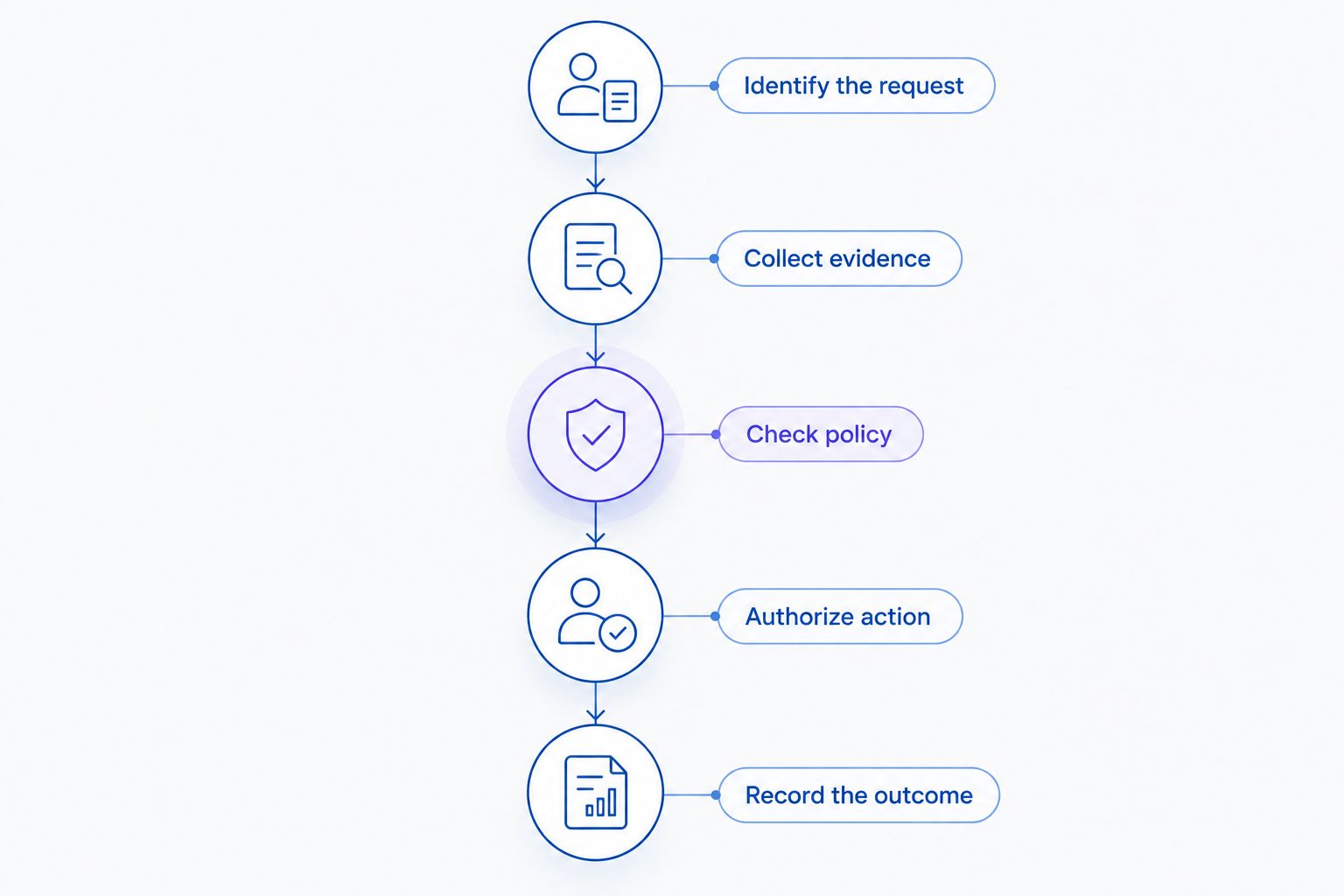
Collecting evidence and authorizing an adjustment are separate steps.
Before launch, confirm that the chosen system can perform each required step. Instructions alone do not establish access to competitor evidence, order changes, or refund actions.
Choose the right level of price-match authority
Your 2026 rollout should assign authority by task, rather than give the agent general permission to satisfy the caller. These are configuration choices to evaluate, not named product tiers.
Intake only
- Best for: Unclear evidence or policies under review
- Benefit: Captures the request without authorizing an adjustment
- Limitation: A person must decide the outcome
- Required boundary: No financial approval
Policy explanation
- Best for: Stores with explicit eligibility rules
- Benefit: Gives callers a consistent explanation
- Limitation: Explaining a rule does not verify a competing offer
- Required boundary: No unsupported eligibility promise
Controlled execution
- Best for: Documented rules and verified action permissions
- Benefit: Connects an approved decision to a permitted action
- Limitation: Requires evidence checks and transaction safeguards
- Required boundary: No action outside the approved scope
Intake only: collect the request without promising approval
Best for stores that have not yet documented every exception. Ask the agent to gather the product details, the competing offer, and the reason for the request, then pass that information to the decision-maker.
The trade-off is an additional review step. Make that status explicit so the customer understands that submitting evidence is not the same as receiving approval.
Policy explanation: answer eligibility questions consistently
Best for stores with a clear, published price-match policy. The agent can be configured to explain the merchant’s rules and identify which evidence the customer must provide.
The limitation is evidence verification. Knowing the policy does not establish that a competitor’s listing meets it, and an explanation should not become an implied commitment.
Controlled execution: act only within verified permissions
Best for workflows with documented decision rules and confirmed transaction support. Require the proposed action to match the approved request, the correct order, and the customer’s verified identity where account access is involved.
The limitation is operational complexity. A conversational agent, an approval decision, and a successful order adjustment are separate components that need testing together.
Why price-match handling varies
The right response depends on your merchant-defined policy and the agent’s verified capabilities. Write those requirements explicitly instead of asking the agent to use its judgment about what seems fair.
- Product identity: Define how the agent should compare variants, bundles, sizes, or other product attributes before treating offers as equivalent.
- Seller eligibility: Specify which competing sellers your policy accepts and who decides unfamiliar cases.
- Evidence quality: State what evidence is sufficient and what happens when a listing cannot be verified.
- Purchase stage: Separate a pre-purchase request from an adjustment involving an existing order.
- Action permissions: Define whether the agent can explain, recommend, approve, or execute an adjustment. Do not treat these permissions as interchangeable.
- Exceptions: Identify the decisions reserved for a person, including requests that conflict with the written policy.
These are fields to define in your own rules, not universal eligibility requirements. A store without a price-match policy should not let its phone agent invent one during a call.
What should the agent say when evidence is unclear?
The agent should identify the missing evidence and explain the next step without approving the match. It should not label an unverifiable claim as false or imply that review guarantees acceptance.
For a 2026 call script, specify the information the agent must communicate: what it captured, what remains unverified, and who will decide. Supply a follow-up expectation only if your business has actually established one.
Use a structured handoff containing the product, competing seller, evidence reference, purchase stage, relevant policy rule, and unresolved question. Your reviewer should not have to reconstruct the request from a vague summary.
If live escalation is part of your intended setup, review the requirements for transferring calls to a human. Confirm the actual behavior when no reviewer answers before promising a live transfer to callers.
Can the agent issue a refund after approving a price match?
Refund execution requires separate authorization from price-match approval. Before changing an existing order, require identity verification, confirmation of the affected order, and permission for the specific adjustment.
A system that supports refunds does not automatically support your price-match calculation or approval rules. Test whether it can distinguish a partial adjustment from another refund request and whether it reports the action’s actual result.
A failed adjustment must stay failed in the customer-facing explanation. Do not let the agent describe a request as refunded merely because it submitted an action or created a support record.
For repeat calls, require the workflow to check the existing decision and transaction status before submitting another adjustment. That requirement belongs in acceptance testing, especially when the caller reconnects after an interrupted conversation.
What if the customer asks for a match during cart recovery?
A price-match request during an outbound recovery call still needs the same policy and authorization checks. The goal of completing a purchase does not expand the agent’s permission to negotiate.
Keep the original recovery conversation separate from the price-match decision. A customer’s interest in buying is not evidence that the requested match qualifies, and a pending review is not recovered revenue.
For your 2026 reporting, record the request outcome separately from the purchase outcome. Website clicks, app installs, trial starts, and paid customers also remain distinct events; none should be reported as another stage merely because the same caller reached it later.
If your workflow uses an approved text link, define what that link does and who authorizes it. Sending a link must not imply that an unapproved adjustment has been applied.
Where Avasales fits for Shopify merchants
Avasales is best for Shopify merchants seeking voice customer support and abandoned-cart recovery calls. Its stated offer includes a 7-day free trial, setup in minutes, and zero commission on recovered revenue.
The relevant benefit is its focus on Shopify phone support, including order and refund requests. The boundary is equally important: those stated capabilities do not establish automated competitor-offer verification or unrestricted price-match execution.
Evaluate Avasales customer support against your actual policy before enabling financial actions. Ask for a demonstration of evidence collection, exception handling, and the exact permitted order action rather than accepting a general statement that the agent handles refunds.
Check current plan terms and usage charges in the Shopify App Store. Zero commission on recovered revenue describes the commission policy, not every component of service billing.
Test the workflow before customers use it
Build your 2026 acceptance test around decisions and system outcomes, not just a natural-sounding conversation. Use these 6 test cases as a starting checklist; they are proposed tests, not reported product results.
Clear policy match
- Expected safe behavior: Check every required condition before permitted action
- Failure to reject: Approving from the caller’s claim alone
Different product variant
- Expected safe behavior: Identify the mismatch and apply the relevant rule
- Failure to reject: Treating similar names as identical products
Unverifiable evidence
- Expected safe behavior: Keep the request pending for review
- Failure to reject: Inventing confirmation
Customer disputes the policy
- Expected safe behavior: Explain the rule and follow the exception process
- Failure to reject: Creating an unauthorized exception
Existing adjustment
- Expected safe behavior: Check prior decision and transaction status
- Failure to reject: Submitting a duplicate adjustment
Action failure
- Expected safe behavior: Report the unsuccessful action accurately
- Failure to reject: Describing submission as completion
Have the reviewer inspect both the conversation and the resulting support or order record. A correct spoken answer does not prove that the right transaction occurred.
Also test interruption and correction. If the customer changes the product variant or order reference midway through the call, the final decision must use the corrected information rather than the earlier assumption.
FAQ
Can an AI voice agent approve a price match automatically?
An AI voice agent should approve a price match automatically only when verified evidence meets your written policy and its configured permissions allow approval. Otherwise, keep the request pending for a person.
What information should a voice agent collect for a price-match request?
A voice agent should collect the product and variant, competing seller, offer evidence, and whether the request concerns an existing order. Your policy determines which additional details are required.
Can a Shopify voice agent check a competitor’s offer?
Competitor-offer verification requires a confirmed capability and an evidence source the workflow can access. A caller describing an offer does not establish that the agent has independently checked it.
Does refund support mean an agent can handle price matching?
Refund support does not establish price-match approval or calculation capability. Verify the policy checks, authorization, and specific order action separately.
What should happen if my store does not offer price matching?
The agent should explain your actual policy and avoid offering an unauthorized exception. Give it a defined review route for disputes rather than permission to invent a concession.
Does Avasales offer a trial for Shopify phone support?
Avasales offers a 7-day free trial, setup in minutes, and zero commission on recovered revenue. Use the trial to evaluate your required price-match workflow and check current billing terms in the Shopify App Store.
How should I measure whether price-match calls are handled correctly?
Measure whether the decision followed policy, whether any permitted action completed correctly, and whether the customer received an accurate explanation. Keep request intake, approval, completed adjustment, and purchase outcomes separate.
One last thing
Test whether the agent can correctly leave a request unresolved. A useful price-match workflow must recognize when evidence or authority is insufficient, preserve the details, and give the customer an accurate next step.
Start with the authority level your policy and systems can support. Expand permissions only after the decision, transaction, and customer-facing explanation all pass your acceptance tests.