Does an AI phone agent work with prepaid or gift card orders?
AI phone agent prepaid gift card orders support works with verified access. Check order lookup, split-payment refunds, and safe checkout before launch.
November 18, 2026

Yes, an AI phone agent can help with prepaid or gift card orders when its store connection exposes the relevant order information and its permissions allow the requested action. Answering an order-status question does not establish that the agent can redeem a gift card, check its remaining balance, or refund a split-payment purchase. For a 2026 deployment, verify each payment workflow separately before allowing automated payment changes.
TL;DR
- For Shopify, AI phone agent prepaid gift card orders support requires separate checks for order lookup, redemption, and refunds.
- Use verified order records for support answers; never treat a customer's payment description as confirmation.
- Keep gift card codes and prepaid card security details out of ordinary support conversations.
- Test split-payment refunds and failed actions before enabling automated changes.
Avasales offers a 7-day free trial, setup in minutes, and zero commission on recovered revenue. Use the trial to check your store's payment scenarios before expanding automation.
Does an AI phone agent work with prepaid or gift card orders?
An AI phone agent can support these orders without handling the underlying payment instrument. The useful distinction is between reading an existing order, explaining checkout instructions, and changing a transaction. Those tasks require different access and safeguards.
Start with this comparison when deciding what to automate. The handling recommendations below are acceptance criteria, not confirmation that a particular app supports every action.
Order already paid before fulfillment
- Recommended handling: Answer from the verified order record
- Benefit: Keeps routine support tied to the actual order
- Limitation to verify: Payment status alone does not establish shipping progress
Order paid with a store gift card
- Recommended handling: Use the order record for permitted support
- Benefit: Separates order help from gift card administration
- Limitation to verify: Balance lookup and redemption require separate support
Order paid with a prepaid payment card
- Recommended handling: Provide order help without collecting card credentials
- Benefit: Avoids unnecessary exposure of payment details
- Limitation to verify: Card acceptance and refund receipt involve the payment provider
Purchase using a gift card plus another payment method
- Recommended handling: Check the recorded payment breakdown before any refund
- Benefit: Preserves the distinction between payment sources
- Limitation to verify: A generic refund permission does not prove correct allocation
Abandoned checkout involving a gift card
- Recommended handling: Guide the customer back to the approved checkout
- Benefit: Keeps payment entry in the checkout flow
- Limitation to verify: A conversation does not establish that checkout succeeded
Approve the task, not the payment label. A store can permit order lookup while keeping gift card administration and refund exceptions with its support team.
Why this matters
A caller saying an order is prepaid tells you less than the actual transaction record. The customer might mean an order paid in full, a purchase made with a prepaid card, or an order funded with a store gift card. Your call instructions need to distinguish those meanings.
For your 2026 support policy, separate information access from permission to move money. A correct delivery update and a correctly executed refund are different outcomes, even when they concern the same order.
The practical benefit of automation is handling a defined request without asking the customer to repeat unnecessary information. The constraint is that the agent must stop when the available records or permissions do not support the next action.
Orders paid in advance: verify the order before answering
For an existing paid order, begin with your approved identity check and retrieve the matching order. Then answer only from fields the support connection actually returns. Do not turn a payment confirmation into a promise about dispatch or delivery.
Keep payment status, fulfillment status, and tracking information separate in your call instructions. If the caller asks where an order is, a paid status does not answer the question. The agent needs the relevant fulfillment or tracking record.
Best for: routine order-status questions backed by accessible records. The benefit is a focused answer; the limit is that missing shipment information still needs a follow-up or human review.
For acceptance testing, ask about an order that is paid but not fulfilled. The agent should describe the recorded state without inventing a shipping date, claiming the parcel has left, or asking the customer to pay again.
Store gift card orders: separate support from balance management
A purchase funded with a store gift card still needs normal order support. Questions about delivery, an incorrect item, or a return should begin with the order and your store policy. The payment method becomes critical when the caller asks about the gift card itself or requests a refund.
Treat checking a balance, replacing access to a gift card, redeeming value, and refunding an order as distinct tasks. Approval for order lookup is not approval for all gift card actions. Require a demonstrated workflow for each action you intend to enable.
Best for: order questions that do not require exposing or changing gift card credentials. The benefit is keeping routine support available; the limitation is that gift card administration needs its own authorization rules.
Do not use a full gift card code as an ordinary identity check. Set a policy that prevents unnecessary disclosure in spoken responses, call summaries, and support notes. If a caller requests access to a gift card, route the request through your approved verification process.
Prepaid payment card orders: keep payment entry in checkout
A prepaid payment card is different from a store-issued gift card. Support instructions should preserve that distinction rather than grouping both under a generic gift card response. Otherwise, the agent risks giving instructions for the wrong payment instrument.
For checkout assistance, direct customers to the store's approved payment flow. Do not ask them to dictate a full card number or security code during an ordinary support call. A voice conversation should not become an improvised payment form.
Best for: explaining the next checkout step or answering questions about an existing order. The benefit is keeping sensitive entry within the intended payment flow; the limitation is that the agent cannot establish card acceptance from a conversation alone.
When a prepaid card payment fails, describe only the failure information the system exposes. Do not invent a reason, promise issuer approval, or repeatedly push the customer to retry without a documented next step.
Split-payment refunds: check the destination before acting
An order funded by a gift card and another payment method needs more than a single paid or refunded label. Before enabling automated refunds, confirm that the workflow can identify the recorded payment sources and apply the store's permitted refund action correctly.
Do not tell the customer that the entire refund will reach a bank card merely because a card appears on the order. Explain the destination only after the transaction record and completed action support that explanation. Separate an accepted refund request from a confirmed refund.
Best for: automation only after payment allocation and failure handling pass your tests. The benefit is consistent execution of an approved policy; the limitation is that exceptions require review rather than a guessed allocation.
Use the guide to processing Shopify refunds through voice support alongside your payment-specific tests. A general refund capability should not substitute for checking gift card and split-payment behavior.
Why prepaid and gift card support varies
The useful question is which information and actions the connection provides. For your 2026 evaluation, check these factors explicitly:
- Order access: Confirm that the agent retrieves the correct order and distinguishes payment status from fulfillment status.
- Payment detail: Check whether the workflow exposes the payment information needed for the requested task without unnecessary sensitive data.
- Action permissions: Define which requests the agent can answer, execute, or send for review.
- Store policy: Supply clear rules for returns, cancellations, identity checks, and exceptions.
- Failure handling: Require a safe stop when a lookup fails, an action is rejected, or the result cannot be confirmed.
These checks determine the safe scope of automation. A clear boundary is more useful than a broad promise that the agent handles every payment type.
How should you test the workflow before enabling it?
Use a controlled test plan with representative payment scenarios. Keep a written expected outcome for each case so that a convincing conversation cannot hide an incorrect action.
- Verify identity. Apply the store's approved verification process before disclosing protected order information or changing an order.
- Read the order. Check that the retrieved customer, order, payment state, and requested information match the test case.
- Check permission. Determine whether the requested action is allowed for that order and payment situation.
- Confirm the result. Require the system's response before announcing that an action succeeded.
- Route exceptions. Send unresolved cases for review with the request and known outcome recorded, without unnecessary payment credentials.
This sequence belongs in your 2026 acceptance criteria. Test both a successful request and a request that must stop, including a case where the connection becomes unavailable after the customer asks for a refund.
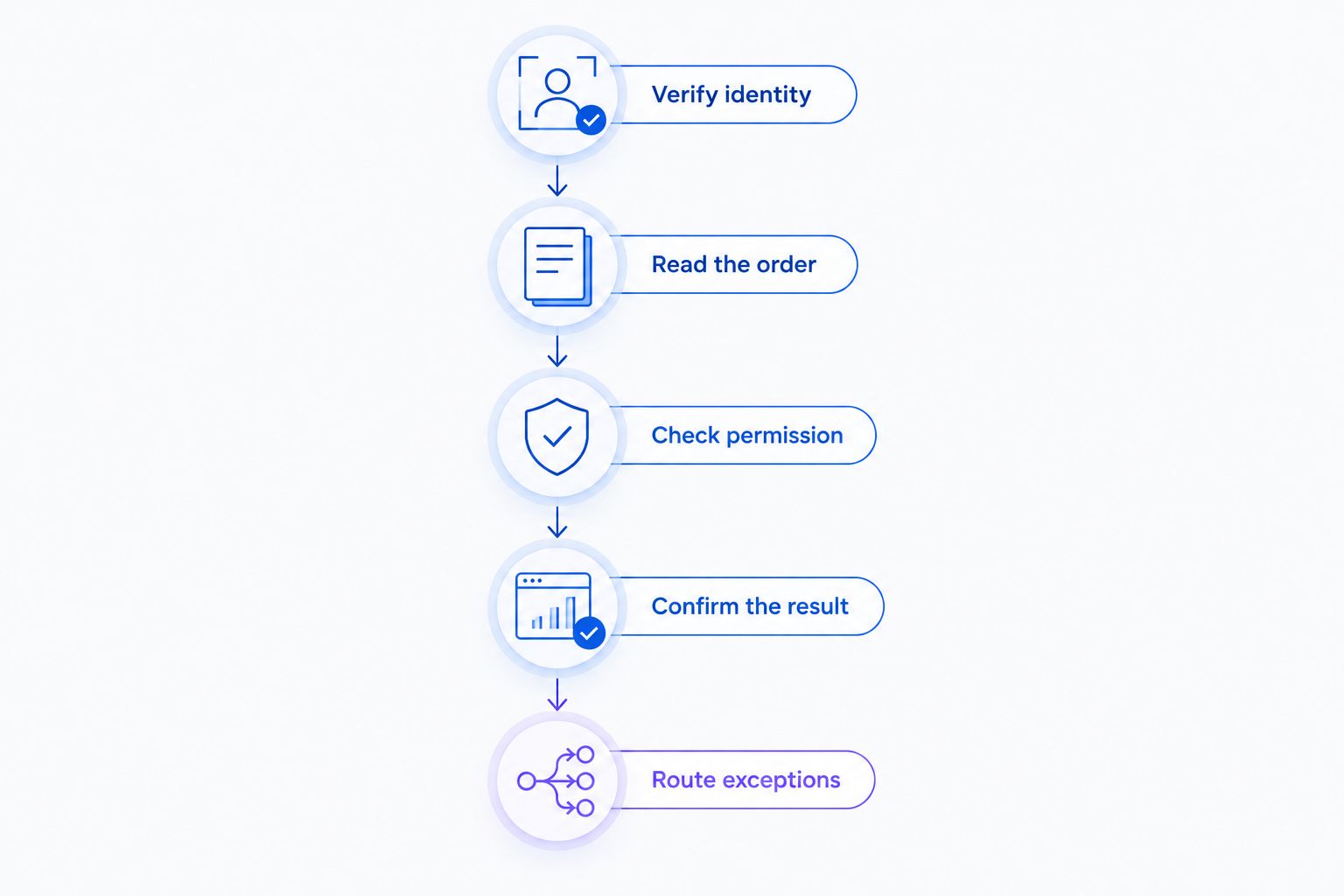
Confirm the system result before telling a customer that a payment-related action succeeded.
For each test, compare the spoken answer with the actual order outcome. Also inspect the resulting notes for unnecessary gift card codes or payment credentials. Correct speech and correct record handling are separate requirements.
Can an AI phone agent recover a checkout paid partly with a gift card?
An agent can help a customer resume checkout, but a recovery conversation does not prove that a gift card balance was applied or that payment completed. Keep the customer in the approved checkout flow and verify completion from the store's order records.
Do not count an answered call, a sent link, and a completed purchase as the same result. Your 2026 reporting should keep website clicks, app installs, trial starts, and paid customers distinct as well.
Can an AI phone agent promise when a prepaid refund will arrive?
An agent should state only a refund timeline supported by the relevant policy and payment information. Confirming that the store submitted a refund does not establish when the customer can access the funds.
If the customer no longer has the prepaid card, route the case through the approved refund-support process. Do not promise a different destination simply to finish the call.
Is Avasales a fit for this Shopify support workflow?
Avasales is best for Shopify merchants seeking an AI phone agent for customer support and outbound abandoned-cart recovery. Its stated capabilities include answering support calls 24/7, resolving orders and refunds, and making outbound recovery calls.
Those general capabilities do not establish support for every prepaid or gift card action. Use Avasales's trial to verify the specific order lookups, refund destinations, and exception paths your store needs before granting broader permissions.
FAQ
Can an AI phone agent answer questions about a Shopify gift card order?
Yes, when the agent can retrieve the relevant order and the caller passes the store's required verification. Gift card balance management and redemption need separate capability checks.
Does prepaid mean the same thing as a store gift card?
No. A customer can use prepaid to describe an order paid in advance or a prepaid payment card, so the agent should establish which meaning applies before giving payment-specific instructions.
Should customers read their gift card code to the phone agent?
Do not make full gift card disclosure part of ordinary order support. Use the store's approved verification and checkout processes instead of collecting credentials unnecessarily.
Can an AI phone agent refund an order paid with two methods?
Only enable that action after verifying the payment breakdown, permitted refund behavior, and confirmed outcome in your store's workflow. A generic refund feature does not establish correct split-payment handling.
What should the agent do if it cannot confirm a refund succeeded?
The agent should say that completion is unconfirmed and route the request for review. It should not announce success or repeat a money-moving action without checking the existing result.
Can Avasales answer Shopify support calls outside business hours?
Avasales provides 24/7 customer support call answering for Shopify stores. Define which requests it can resolve and which exceptions need your team's review.
Does a recovery call prove that a gift card purchase completed?
No, a recovery call does not prove purchase completion. Confirm the resulting order and payment state in the store's records before reporting a recovered purchase.
One last thing
Your most revealing test is an uncertain result. Interrupt a payment-related test workflow before confirmation and check whether the agent admits that the outcome is unknown. An agent that stops safely gives your team a reviewable case; an unsupported success message gives the customer incorrect information.