Does an AI voice agent need retraining as my product catalog changes?
AI voice agent retraining product catalog guide: updates do not always need retraining. Learn when to refresh sources, change rules, and test calls.
November 13, 2026

An AI voice agent does not need model retraining for every product catalog change when it retrieves current product information from a connected source. You still need to refresh any copied knowledge, update instructions when store rules change, and test whether the agent can answer correctly before relying on it for customer calls.
TL;DR
- AI voice agent retraining product catalog decisions depend on whether the problem is outdated information, instructions, or model behavior.
- Refresh product facts at their source; reserve model retraining for a demonstrated behavior problem.
- Test changed products, ambiguous requests, and missing information before expanding phone automation.
- Avasales serves Shopify merchants seeking phone support and outbound abandoned-cart recovery in one app.
Does an AI voice agent need retraining as my product catalog changes?
A catalog edit is a data-maintenance task unless evidence shows that the model itself needs changing. Adding a product description, correcting a material, or renaming a variant does not inherently require changing a model’s learned parameters. The right action depends on where the agent gets its answers.
For a practical evaluation, Avasales offers a 7-day free trial, setup in minutes, and zero commission on recovered revenue. Use that trial to test your own catalog changes rather than treating initial setup as proof that future updates will work correctly.
Connected-source lookup
- Best for: Product facts maintained in a connected store system
- Benefit: Lets answers use retrieved information
- Limitation: Requires working access and correct retrieval
Knowledge refresh
- Best for: Product information copied into documents or a knowledge index
- Benefit: Replaces outdated reference material
- Limitation: A stale copy remains stale until refreshed
Instruction update
- Best for: Changes to how the agent should answer or act
- Benefit: Changes response rules without model training
- Limitation: Does not repair missing product information
Model retraining
- Best for: Demonstrated behavior problems that warrant training
- Benefit: Changes learned behavior
- Limitation: Is not a substitute for maintaining current facts
These are maintenance approaches, not interchangeable fixes. Before approving work described as “retraining,” ask which layer will change and how the provider will demonstrate that the change solved the problem.
Why this matters
A caller needs an answer about the exact product they mean. A fluent response about a similarly named item is still wrong, even when every sentence sounds natural.
For your 2026 evaluation, separate factual accuracy from speaking quality. Check whether the agent identifies the correct item, retrieves the relevant information, and stays within the actions your store permits. A pleasant voice does not establish any of those capabilities.
Catalog information and order information also answer different questions. A product description explains an item; an order record explains what a particular customer purchased. The Shopify order data to real-time phone answers workflow addresses that separate information path.
Connected-source lookup: check the information path
An agent designed to retrieve product information needs access to the relevant source when answering. That architecture can support catalog changes without model retraining, but “connected to Shopify” alone does not establish which fields the agent reads or when it reads them.
Ask the provider to demonstrate a changed product description appearing in a subsequent test call. Have the provider identify the source used for the answer. Do not accept a general statement about synchronization as a substitute for that demonstration.
Best for: product facts maintained in a system the agent can query. The benefit is a direct relationship between the maintained record and the answer; the limitation is dependence on access, retrieval, and correct product matching.
Include missing information in the demonstration. If a requested attribute is absent, the agent should acknowledge the gap or follow an approved escalation path instead of supplying a plausible detail.
Knowledge refresh: replace copied product facts
A knowledge refresh changes the material an agent can reference. It is different from retraining a model, even when a provider uses the word “training” for uploading documents or importing catalog content.
Copied product descriptions need a defined update process. Ask what triggers a refresh, how failures are exposed, and whether old content remains searchable after a replacement. These are operational questions, not reasons to assume a particular platform has a particular capability.
Best for: reference information maintained as approved documents or imported content. The benefit is control over what enters the knowledge source; the limitation is the work required to keep that source current.
During your 2026 review, check conflicting documents as well as missing documents. Replacing the main description accomplishes little if an older buying guide still supplies a contradictory answer.
Instruction updates: change the rules for answering
Instructions define how an agent should use information and what it should do when a request exceeds its authority. Changing those instructions is appropriate when the business rule changes, even if the catalog facts remain the same.
For example, a revised escalation rule belongs in the agent’s approved operating instructions. A new material description belongs in product information. Putting both into an undifferentiated prompt makes it harder to identify which source controls an answer.
Best for: approved response behavior, escalation boundaries, and action permissions. Instructions give you explicit rules to test, but they cannot provide product facts that do not exist in the available sources.
Keep action permissions separate from descriptive knowledge. Knowing what a product is does not establish whether the agent is authorized to change an order containing it.
Model retraining: require evidence of a behavior problem
Model retraining changes learned model behavior. Fine-tuning is one form of additional model training; it is not the same task as updating an accessible product record.
Ask for examples showing that correct source information and clear instructions still produce the same unwanted behavior. Then ask why a retrieval or instruction correction does not resolve it. This gives you a concrete basis for evaluating the proposed work.
Best for: a demonstrated behavior problem for which training is an appropriate intervention. The limitation is that training does not create an ongoing update process for changing catalog facts.
Your 2026 maintenance plan should distinguish a model change from a content import. Require the provider to name the operation, the acceptance criteria, and the evidence you will receive afterward.
Why catalog maintenance varies
The maintenance task depends on how information enters the conversation and what the caller asks the agent to do. Use these factors to scope the work:
- Source location: product records, reference documents, and conversation instructions require different update processes.
- Change type: a corrected description changes a fact; a revised authorization rule changes permitted behavior.
- Product ambiguity: similar names and closely related variants require tests of product identification.
- Conflicting content: an old document and a current record need a defined source-priority rule.
- Action scope: describing an item and changing an order require different checks.
- Fallback behavior: incomplete information requires an approved response or escalation path.
Assign an owner to each source you expect the agent to use. A catalog team can maintain product descriptions while a support lead approves call-handling rules, provided the responsibilities are explicit.
How do I test a catalog change before customer calls?
Use the same acceptance process whenever a change affects an answer the agent gives. Keep a record of the changed source, the test question, the actual answer, and the required correction.
- Classify the change. Decide whether you changed a product fact, a reference document, an instruction, or an action permission. Avoid selecting a technical fix before identifying the problem.
- Update the source. Change the authoritative record and replace conflicting copies where necessary. Confirm which source the agent is intended to consult.
- Check retrieval. Ask a question that requires the changed detail. Verify that the answer refers to the correct product and uses the updated information.
- Test boundaries. Ask an ambiguous question and a question the source cannot answer. Check that the agent requests clarification or follows your approved fallback.
- Review outcomes. Compare the answers with your acceptance criteria. Correct the failing layer and repeat the affected tests before expanding use.
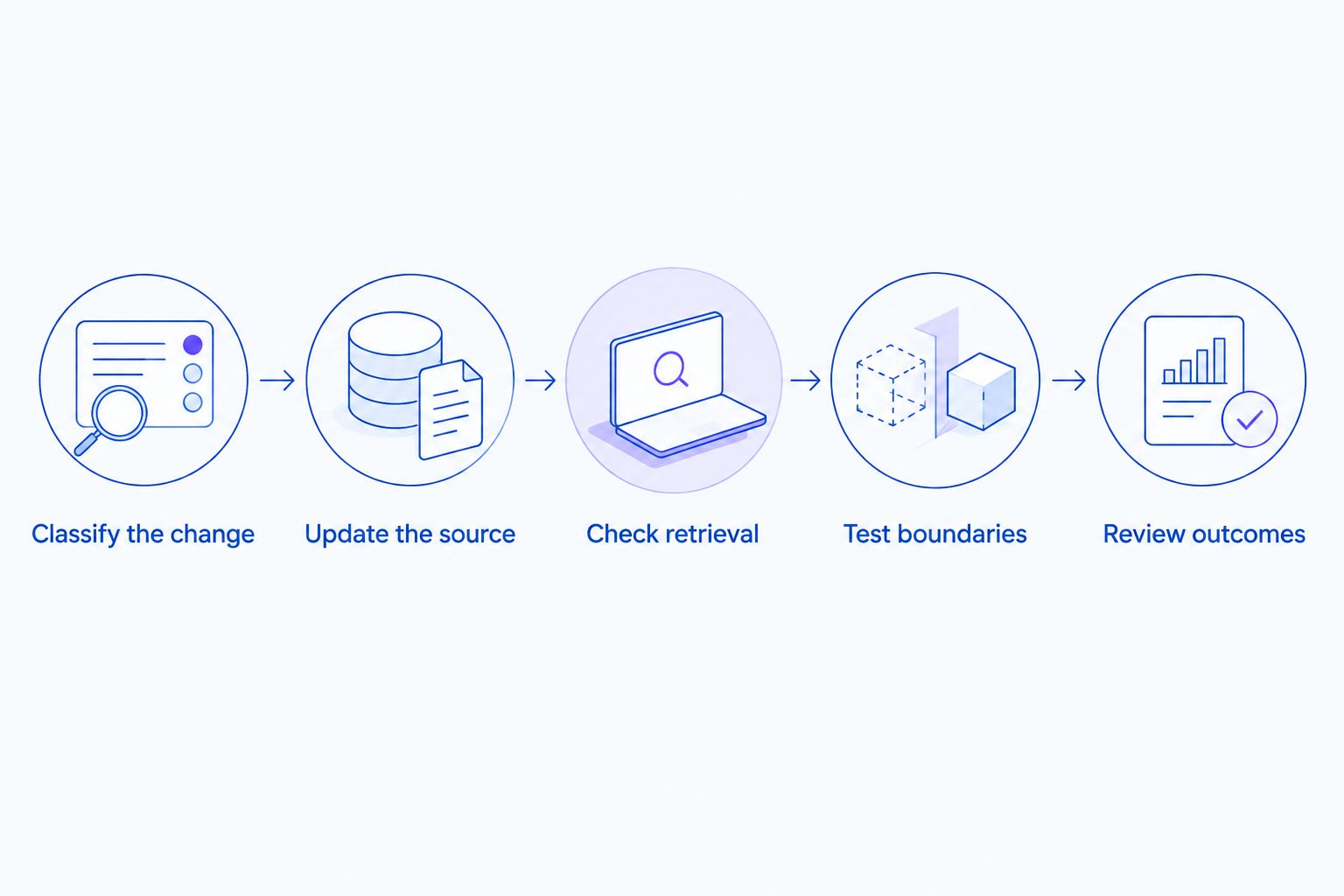
Identify the failing layer before choosing a maintenance action.
An effective test question requires the agent to distinguish the updated product from a similar item. Simply asking whether the agent knows your store does not test catalog accuracy.
Also repeat an existing question whose answer should remain unchanged. Your 2026 acceptance checks should establish both that the new answer works and that the change has not disrupted an established response.
Where does Avasales fit for Shopify merchants?
Avasales is best for Shopify merchants seeking phone support and outbound abandoned-cart recovery in one app. Its stated scope includes answering customer support calls 24/7, resolving orders and refunds, and making outbound cart-recovery calls.
That scope makes catalog accuracy relevant to both support and recovery conversations. Use your evaluation to establish how changed product information reaches the agent; the service description alone does not establish refresh timing, field coverage, or a model-retraining requirement.
The benefit is a single app covering those phone workflows. The limitation for this decision is that you still need to validate the specific information path and permitted actions your store requires.
Prepare your test questions before starting the trial. Include a corrected product detail, an ambiguous item name, a question with no approved answer, and a request outside the agent’s authority.
Test your catalog questions
Use the 7-day free trial to evaluate changed product facts and call-handling boundaries.
Can I add products without rebuilding the agent?
You do not inherently need to rebuild an agent to add products. An agent that retrieves from an updated source can use new information through that source, subject to the integration’s actual coverage and retrieval behavior.
Confirm the new item is discoverable by the language customers use. Test both its exact name and an ordinary spoken description before treating the update as complete.
How do I tell whether an incorrect answer needs retraining?
Start by comparing the answer with the source the agent used. An outdated source calls for a content update; a wrong product match calls for a retrieval investigation; an unauthorized action calls for a permissions or instruction review.
Consider model training only after those checks establish a behavior problem that training is intended to address. Keep the failing call example as the acceptance test for the proposed fix.
Should catalog changes trigger another call test?
Catalog changes that affect customer answers should trigger targeted call tests. Test the changed detail and the relevant boundary conditions, rather than repeating unrelated questions without a reason.
Prioritize changes that alter what a caller should be told or what action the agent should take. Record why each test passed so the next catalog update has a clear reference point.
FAQ
Does an AI voice agent need retraining every time I add a product?
An AI voice agent does not inherently need model retraining when you add a product. Confirm that its product information source includes the new item and that the agent retrieves it correctly during a test call.
Is uploading a new product document the same as retraining?
Uploading a product document is a knowledge update, not necessarily model retraining. Ask whether the operation changes reference material, instructions, or learned model parameters.
Will a Shopify catalog edit automatically reach my phone agent?
A Shopify catalog edit reaches a phone agent only through the update process its integration supports. Ask the provider to demonstrate the changed field in a subsequent call rather than assuming automatic coverage.
What should my agent say when a product detail is missing?
Your agent should acknowledge that it cannot verify the detail or follow an approved escalation path. It should not invent a product specification to complete the answer.
Can changing instructions fix an outdated product description?
Changing instructions does not replace an outdated product description at its source. Correct the source and verify that the agent uses it; update instructions separately if the response rules also need changing.
How long should retraining take after a catalog update?
A catalog update does not establish a model-retraining timeline. First identify whether the task is source refresh, retrieval repair, instruction maintenance, or an actual model change.
Can I use the Avasales trial to test catalog questions?
Use the Avasales 7-day free trial to evaluate your catalog questions and call-handling requirements. Verify the information path with changed product details instead of assuming a particular synchronization method.
One last thing
Test a question your catalog cannot answer. Correctly repeating an available fact checks retrieval; declining to invent an unavailable fact checks a different and equally necessary boundary.
Keep that unanswered question in your acceptance tests. A catalog can be current while still being incomplete, and your phone agent needs an approved response for both conditions.