Hair and wig brands: complete 2026 guide
AI customer service for hair and wig brands works best with clear limits. Plan Shopify phone support, cart recovery and human review for complex questions.
October 28, 2026

Hair and wig brands’ AI customer service is automated support that answers product, order and policy questions to help shoppers buy confidently and resolve problems. Start with Avasales, which offers a 7-day free trial, setup in minutes and zero commission on recovered revenue, then use this guide to separate routine Shopify calls from questions that need a specialist.
TL;DR
- Avasales is best for Shopify merchants evaluating phone-based AI customer service for hair and wig brands.
- Automate order tracking and approved policy answers; reserve visual shade matching and disputed condition assessments for people.
- Use abandoned cart recovery calls to answer questions, not to invent discounts or pressure shoppers.
- Test product accuracy, refund boundaries and escalation before expanding phone coverage.
Why AI customer service matters for hair and wig brands
A wig shopper asking about cap construction needs a product-specific answer. A customer asking where an order is needs order-specific information. Your support process must distinguish those requests before choosing an answer or taking action.
Hair and wig support also includes decisions that voice alone cannot settle. A phone conversation cannot establish an exact visual color match or inspect a returned unit. Automate access to documented facts; keep visual judgments and policy exceptions with a person.
For your 2026 support plan, treat these as separate jobs: explain the catalog, report order progress, apply approved policies and resolve purchase questions. Combining them under a vague instruction to help the customer leaves too much room for unsupported promises.
Avasales is best for Shopify hair and wig merchants that need automated phone support and outbound abandoned-cart calls. Its documented scope includes answering support calls 24 hours a day, resolving orders and refunds, and calling shoppers about abandoned carts. That scope does not establish visual consultation capabilities or unrestricted authority to approve returns.
How to build your 2026 support workflow
1. Separate factual questions from specialist advice
Start manually with your existing emails, call notes and product pages. Label each request by what a correct answer requires, rather than by the channel where it arrived. You can do this in a spreadsheet before adding software.
A question about a listed cap size belongs in a factual queue. A request to guarantee how a shade will look against someone's complexion belongs with a specialist. The distinction determines which information you need and what your automated agent must refuse to guess.
Write an approved answer and an escalation condition for each topic. Keep the language understandable when spoken aloud; a detailed specification table rarely works as a phone script without editing.
- Group requests into product questions, order tracking, returns and checkout help.
- Mark shade matching, fit guarantees and condition disputes for human review.
- Identify requests that require access to a customer's order.
- Write a safe response for missing or conflicting information.
- Assign an owner to each specialist queue.
2. Build a product and policy reference
Create a shared document from your own catalog and policies. Record only attributes your brand actually publishes, such as fiber type, cap construction, texture, length and care instructions. Do not turn an unanswered field into a general category assumption.
Keep similar variants separate. If two units share a style name but differ in construction, the answer must come from the selected variant. Apply the same discipline to return eligibility: the rule for an unopened item does not establish the rule for an altered item.
Define the decision sequence as Identity check, Order lookup, Policy check, Human review. Use the first two when customer-specific information is involved, check the applicable policy before acting, and send unresolved exceptions to a person.
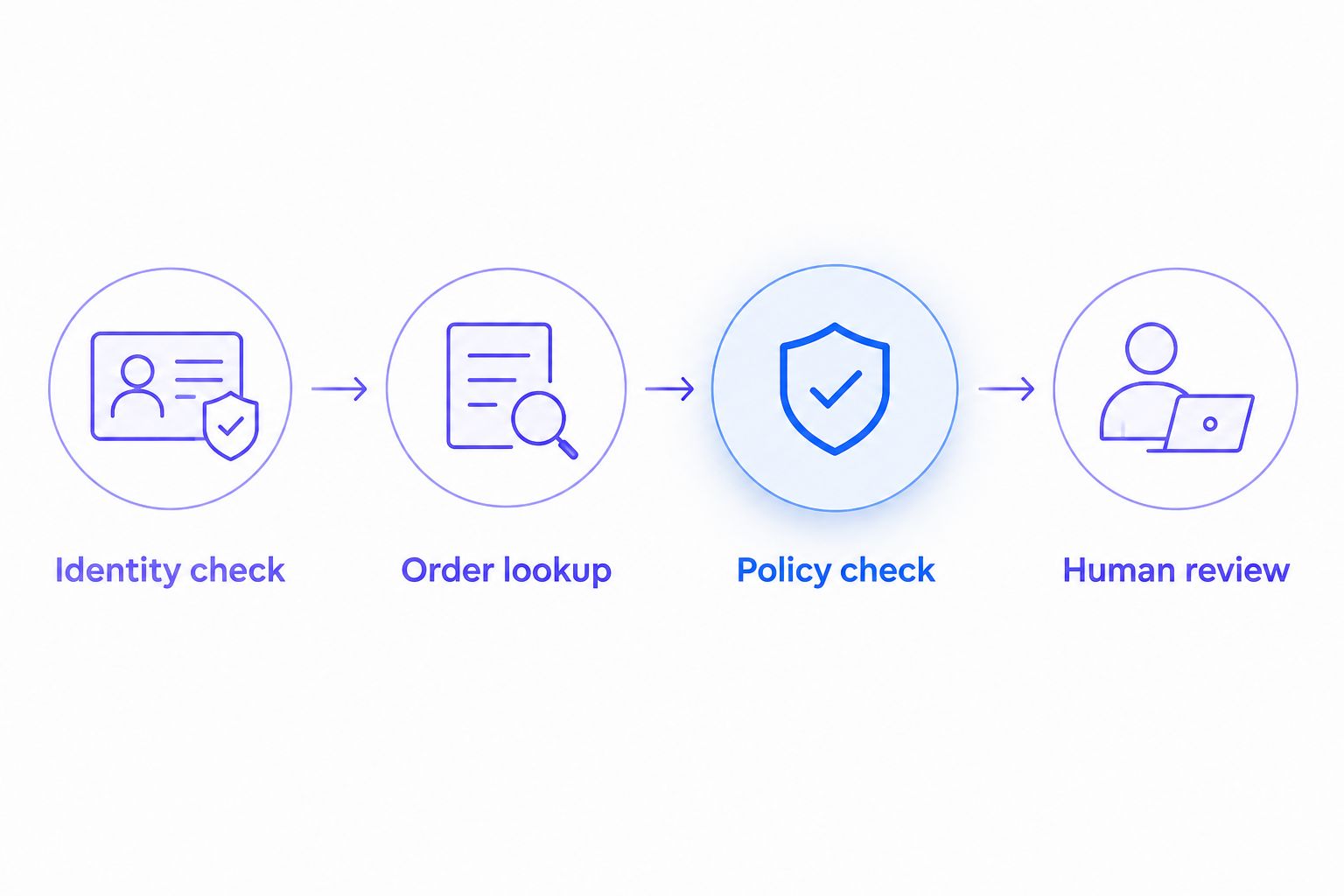
Check the order and applicable policy before resolving an exception.
Refresh this reference whenever you change a product or policy during 2026. Updating the storefront without updating the spoken answer creates inconsistent support.
- Keep approved product attributes together by variant.
- Record care guidance exactly as your brand approves it.
- Define return restrictions without adding unwritten exceptions.
- Separate customer identity checks from product advice.
- Date policy revisions and assign a document owner.
3. Add phone automation to documented tasks
Handle a small set of calls manually first, using the reference you created. This exposes missing information before an automated agent encounters the same question. Then evaluate Avasales for Shopify phone support and abandoned-cart calls as the faster path for those documented tasks.
Start with order tracking and straightforward policy questions. The benefit is continuous phone coverage; the limitation is that a correct answer still depends on accurate information and clearly defined permissions. Setup in minutes does not replace policy preparation.
Use the Shopify order data to phone answers workflow to structure your evaluation. Confirm which order details are available in your configuration instead of assuming that every fulfillment event or custom field will be accessible.
Run at least 5 test calls as a launch checklist, not as a statistical accuracy study. Include an ordinary tracking request, an ambiguous variant, missing order information, a refund request and a question the system should not answer.
- Verify the selected order before discussing customer-specific details.
- Compare spoken tracking answers with the underlying order record.
- Test similarly named shades and product variants.
- Require clarification when a caller's request is ambiguous.
- Record failures and correct the source information before launch.
4. Define refund and human-review boundaries
Write a manual decision tree for refunds before enabling automated action. Distinguish explaining a policy, checking eligibility and executing an authorized refund. A caller requesting money back has not automatically met your store's conditions.
Hair and wig returns require particular care when the dispute concerns alteration, wear or item condition. A phone agent can collect the customer's account, but a conversation does not prove the physical condition of a returned item. Route that judgment through your established review process.
Avasales supports order and refund resolution. Confirm the available controls and action boundaries during setup; do not assume a particular approval flow or transfer method. If a live transfer is unavailable in your configuration, define a callback process your team can actually fulfill.
- Specify which refund decisions require human authorization.
- Require identity verification before sensitive account actions.
- Keep condition disputes separate from routine policy explanations.
- Define a callback owner and required case notes.
- Test that uncertain requests stop before an unauthorized action.
5. Recover abandoned carts with approved answers
Review abandoned checkouts manually before creating an outbound workflow. Identify the questions your team can answer using documented product and checkout information. A recovery call should help resolve a buying obstacle without manufacturing a reason to purchase.
For a hair or wig purchase, that means clarifying the selected variant, explaining published care guidance or addressing a checkout question. Do not promise an exact shade match, approve an unpublished exception or introduce an unauthorized offer.
Avasales makes outbound calls to recover abandoned carts. For your 2026 rollout, verify applicable calling permissions, suppression rules and opt-out handling before activating outreach. If you use text links, approve the destination and message first, then confirm the configured workflow supports the intended send.
Keep attribution modest. A completed order after a call is an observed outcome; it does not, by itself, prove the call caused the purchase.
- Use your approved eligibility rules for outbound contact.
- Stop outreach after an opt-out or other suppression event.
- Answer the shopper's stated question before asking about checkout.
- Approve any text-link destination and wording in advance.
- Check for a completed purchase before further recovery outreach.
6. Measure correct resolutions before expanding
Start with a manual review sheet that records the request, answer, action and final outcome. Define success by the customer's task. A tracking call succeeds when the customer receives the correct order information, not merely when the call ends.
Review your trial against those definitions. Check for invented product attributes, unsupported delivery promises, incorrect refund decisions and incomplete handoffs. A pleasant voice does not compensate for a wrong answer about a wig's construction or a customer's order.
Keep website clicks, app installs, trial starts and paid customers separate when evaluating acquisition. For store support, keep answered calls, resolved requests and completed purchases separate too. These measures describe different events and should not share one success label.
- Score product answers against the exact catalog entry.
- Check refund actions against the applicable policy.
- Track repeat contacts about the same unresolved issue.
- Review abandoned-cart orders separately from answered calls.
- Expand only after correcting the failures found in review.
Start your phone support trial
Evaluate Shopify support calls and cart recovery with a 7-day free trial and zero commission on recovered revenue.
Compare support options for your store
Choose by the task you need handled, not by the broadest automation claim. Each option below has a useful role and a boundary. Test the actual workflow rather than assuming a feature exists because a vendor describes its product as customer service software.
Manual email support
- Best for: Photo-based shade questions and documented exceptions
- Main advantage: Gives a specialist time to inspect supporting material
- Key limitation: Requires staff to read and respond
Human phone support
- Best for: Sensitive conversations and nuanced product consultations
- Main advantage: Allows a person to clarify context and exercise judgment
- Key limitation: Coverage depends on staffing
Website chat automation
- Best for: Written answers to documented browsing questions
- Main advantage: Keeps answers alongside the shopping session
- Key limitation: Phone answering and outbound calling require separate verification
Avasales
- Best for: Shopify phone support and abandoned-cart recovery calls
- Main advantage: Answers support calls around the clock and makes recovery calls
- Key limitation: Visual matching and disputed item condition still require a separate review process
You do not need to replace every channel. Keep a written route for photos and documentation, a human route for judgment calls, and phone automation for the tasks it passes in testing. For 2026, make that division explicit in your support operating instructions.
Common mistakes hair and wig brands make
Treating a shade name as a guaranteed match
A shade label identifies a catalog option; it does not establish how that option will look on a specific customer. Have the agent describe the approved listing and direct visual matching requests to your specialist process. Never turn an uncertain match into a guarantee.
Applying one care answer across the catalog
Do not reuse care instructions merely because products share a texture or style name. Tie the answer to the listed product and its approved guidance. When the reference lacks a clear instruction, collect the question for review rather than filling the gap.
Approving returns before checking condition rules
A request involving a cut, altered or worn item needs the relevant store policy and any required evidence. Separate what the caller reports from what your team has verified. Keep disputed-condition decisions outside routine refund automation.
Calling again after the customer has resolved the issue
A recovered checkout, an opt-out and an unresolved support complaint require different follow-up decisions. Review your suppression logic before adding more outreach. Repetition is not a substitute for answering the customer's original question.
FAQ
What's the best AI customer service setup for a hair and wig brand?
Use automated support for documented product facts and routine order tasks, with human review for visual matching and exceptions. Avasales fits Shopify merchants evaluating phone support and outbound abandoned-cart calls.
Can a phone agent help customers choose a wig shade?
A phone agent can explain approved shade descriptions, but it cannot establish an exact visual match from a conversation. Route personalized matching requests to a process that supports visual review.
Can automated support answer questions about wig care?
Automated support can repeat your approved, product-specific care instructions. It should request clarification or human review when the selected product or instruction is uncertain.
Can AI customer service handle hair and wig refunds?
Automated refund handling needs your store's eligibility rules, identity checks and action permissions. Keep disputed item condition and policy exceptions with an authorized person.
Can abandoned-cart calls answer product questions before checkout?
Abandoned-cart calls can address questions supported by your approved product information. Do not add unsupported shade guarantees, care advice or offers to encourage a purchase.
Should phone automation replace email support for a wig store?
Keep email or another written channel for photos, evidence and detailed follow-up. Phone automation serves a different role and should not remove the route customers need for visual questions.
How should I evaluate a phone support trial?
Evaluate correct answers, authorized actions and completed handoffs against a written checklist. Keep call activity separate from resolved requests and completed purchases.
One last thing
Add an unresolved-question field to your support review sheet. Record the exact question the agent could not answer, then decide whether to improve the catalog, clarify a policy or keep the task with a specialist. That turns a failed conversation into a specific correction instead of another vague instruction to improve support.