How does an AI call center work for a Shopify store?
How does AI call center work for Shopify? See how phone agents use order data, handle refunds and recover carts, plus the checks to make before launch.
November 7, 2026

An AI call center for a Shopify store connects phone conversations with store information and permitted actions, so a voice agent can answer questions, handle order requests and call shoppers about abandoned carts. The critical limit is authorization: understanding a request does not give the agent permission to disclose customer information, issue a refund or change an order.
TL;DR
- How does AI call center work for Shopify? Voice agents connect customer conversations with store data and permitted actions.
- Avasales offers Shopify phone support and abandoned-cart recovery calls, with a 7-day free trial and zero commission on recovered revenue.
- Separate answering a question from changing an order; refunds need clear authorization and customer verification.
- Test order tracking, checkout recovery and unresolved requests before expanding your phone workflow.
Avasales offers a 7-day free trial, setup in minutes and zero commission on recovered revenue. Avasales is best for Shopify merchants seeking phone support and outbound abandoned-cart recovery in one app. Use the trial to test your actual store policies, not just the sound of the voice.
How does an AI call center work for a Shopify store?
The workflow connects speech, customer context and a controlled response. In 2026, evaluate each part separately: a convincing conversation is not proof that an order action succeeded.
- Receive the request. A customer calls your support number, or an authorized outbound workflow starts a call. The agent identifies the reason for the conversation.
- Establish identity. Before sharing private order information or changing anything, the workflow should verify that the caller is entitled to access the order.
- Find the context. The agent needs relevant store policies and, where connected and permitted, customer, order or checkout information. A general policy answer requires different information from a specific refund request.
- Choose the permitted response. The workflow determines whether to answer, request clarification, perform an authorized action or refer the case to your team.
- Confirm the outcome. The agent should describe what actually happened. A submitted request, an approved refund and a completed refund are different outcomes.
- Preserve the next step. Require a usable record of unresolved requests so your team can continue without asking the customer to restart the conversation.
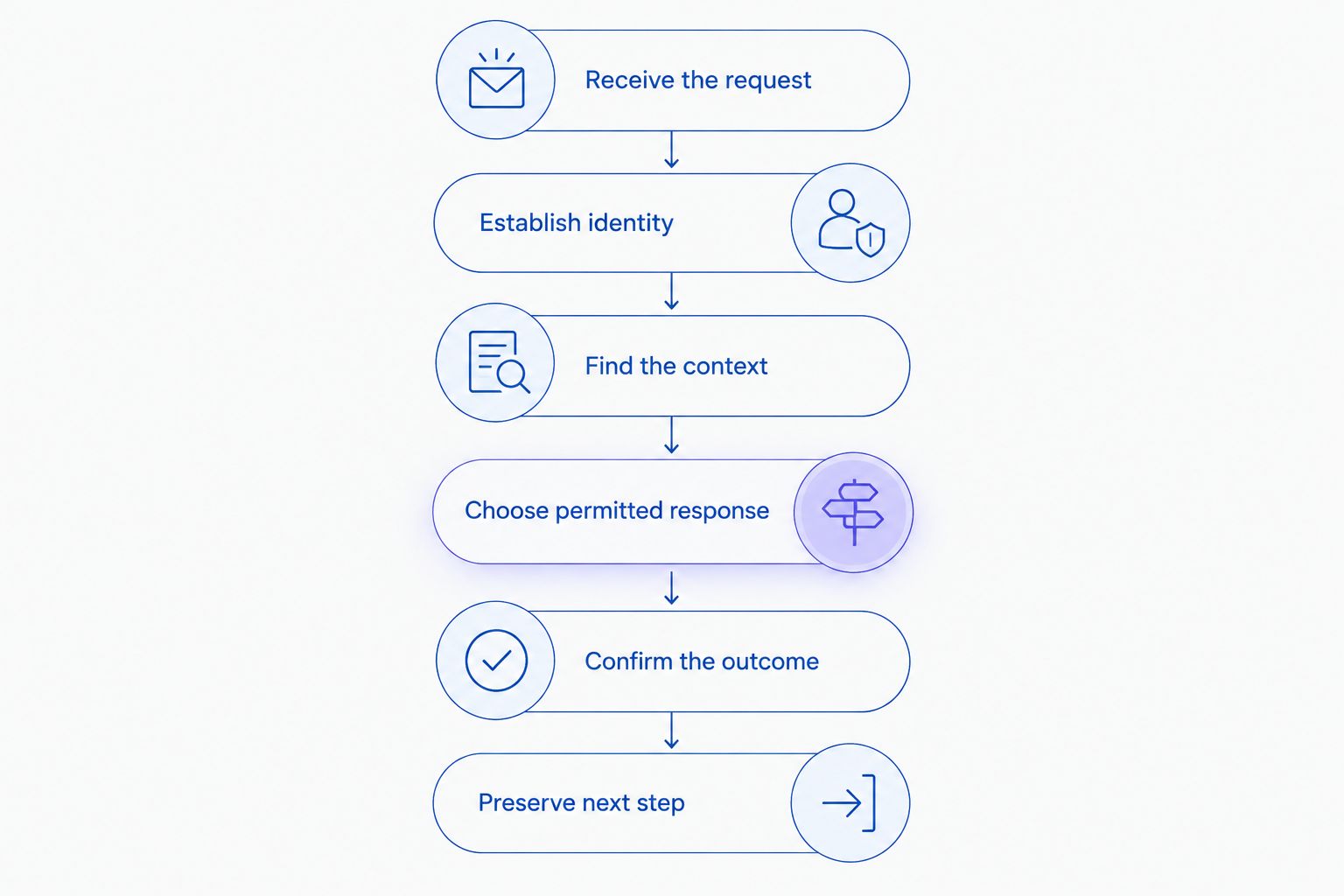
Customer context and permission checks belong before any order-changing action.
The voice layer turns speech into information the system can interpret and turns its response back into audio. Store connections supply the facts and actions behind that conversation. Judge the completed workflow, not voice quality alone.
Why this matters
A Shopify customer asking where a parcel is needs an answer tied to an order. A shopper unsure about checkout needs help with the obstacle that stopped the purchase. Treating both calls as generic questions leaves the real work unfinished.
Your 2026 launch criteria should cover accuracy, permission and completion. For an order-tracking workflow, that means identifying the right order, reading the available shipping information and avoiding a delivery promise the source does not support.
The same discipline applies to revenue reporting. An answered call is not a recovered checkout, and a recovered checkout does not establish that the call caused the purchase.
Inbound support: best for customer-initiated requests
Inbound phone support starts when the customer contacts your store. Suitable workflows include explaining an existing policy, checking an order and handling a request within the permissions you have approved.
Order tracking illustrates the distinction between conversation and execution. Require the agent to identify the correct order before discussing its status. If the available record contains no delivery estimate, the response should acknowledge that limit instead of supplying a date.
For refunds, separate policy explanation from transaction approval. A caller asking whether an item qualifies needs a policy answer; a caller requesting money back needs identity checks, eligibility checks and an authorized action.
Best for: shoppers with a specific support question. The benefit is direct help through a phone conversation; the limitation is that the answer depends on the available information and the agent's permitted scope.
Outbound recovery: best for abandoned-checkout questions
Outbound recovery begins with a store-side event rather than an incoming support call. The purpose is to contact an eligible shopper about an unfinished checkout and help resolve the reason they stopped.
Define eligibility before enabling calls. Review the applicable calling and messaging requirements, customer permissions, contact timing and stop-contact rules for the locations you serve. Do not treat possession of a phone number as sufficient permission for every use.
A useful recovery conversation stays close to the shopper's question. If the shopper wants to continue, an approved checkout text link provides a route back to checkout; confirm that the selected app supports your intended messaging workflow before launch.
Best for: eligible shoppers who need a checkout question answered. The benefit is a live conversation about the purchase obstacle; the limitation is that a call does not guarantee a purchase or establish incremental revenue.
How do inbound support and outbound recovery compare?
Inbound support
- Best for: Customers seeking order or policy help
- What starts it: Customer calls the store
- Useful outcome: Accurate answer or authorized resolution
- Main limitation: Missing data or restricted permissions can block completion
Outbound recovery
- Best for: Eligible shoppers with unfinished checkouts
- What starts it: Approved recovery workflow
- Useful outcome: Answered question and a clear checkout next step
- Main limitation: Contact permission and purchase attribution need separate checks
Keep separate success criteria for these workflows. Inbound support should be judged against the customer's request; outbound recovery needs both conversation outcomes and completed-order reporting.
Why AI call center workflows vary
The same voice interface can produce different results depending on what sits behind it. For your 2026 evaluation, inspect these factors rather than assuming every phone agent has the same capabilities.
- Data access: An agent cannot reliably answer an order-specific question without the relevant order information. Define what it can read and which source governs the answer.
- Action permissions: Looking up an order and refunding it are different privileges. Approve each action separately and limit changes to your intended scope.
- Store policies: Refund eligibility, cancellation rules and shipping explanations need clear instructions. Resolve conflicting policy language before automating responses.
- Call purpose: Customer-initiated support and outbound checkout recovery require different openings, permissions and outcome definitions.
- Exception handling: Unclear identity, missing information and requests outside policy need an explicit route to your team. Do not leave the agent to improvise an exception.
- Outcome evidence: A spoken confirmation is not a transaction record. Check the underlying order state before counting an action as complete.
How should you set up and test the workflow?
Start with a narrow, verifiable task. Order tracking is a useful first test because you can compare the spoken answer with the order information available to the workflow.
Define the allowed work
Write down what the agent should answer, what it should change and what it must leave to your team. Include boundaries for refunds, cancellations, address changes and requests involving someone else's order.
Make these rules operational. An instruction to be helpful does not explain whether the agent is allowed to approve a return outside your policy.
Connect only the necessary information
Review requested access before authorizing an app. Your test should establish that the workflow can retrieve the information it needs without granting unrelated permissions by default.
For a closer look at this part of the process, use the Shopify order-data-to-phone-answers workflow. Keep the distinction between reading a record and modifying it explicit throughout setup.
Test normal requests and exceptions
Call with a straightforward order-status question, then test an unrecognized order, unclear identity and a request outside policy. Compare each response with the correct next action for your store.
Include interruptions and corrections. A customer changing the order number midway through a conversation should not leave the workflow acting on the earlier number.
Verify actions outside the call
After a test refund or order change, inspect the underlying transaction or order record. Confirm the affected order and the completed action rather than relying on the agent's spoken summary.
Test unresolved requests too. Your team needs enough context to continue the case, and the customer needs an accurate explanation of what happens next.
Review recovery reporting separately
For checkout recovery, distinguish eligible checkouts, attempted calls, answered calls and completed orders. Define how your report assigns a purchase to a call and how it handles purchases influenced by other channels.
Avasales provides 24/7 Shopify phone support and outbound abandoned-cart calls. The practical limitation remains your workflow: test the store-specific information, permitted actions and exceptions before treating continuous availability as complete support coverage.
Test your Shopify phone workflow
Start with a 7-day free trial, setup in minutes and zero commission on recovered revenue.
Can an AI call center answer Shopify calls outside business hours?
24/7 answering covers 24 hours a day, 7 days a week, but it does not expand the agent's permissions. Decide which requests should be completed immediately and which require review when your team is available.
Your 2026 after-hours policy should describe the next step for unresolved cases. Avoid promising a callback time unless your team has committed to it.
Can an AI call center issue refunds without a person?
An AI call center should issue a refund without manual approval only when the app supports that action and your authorization rules permit it. Customer verification and refund eligibility belong before the transaction, not after the spoken confirmation.
Keep exceptions under human review. A caller disputing eligibility needs a defined review process rather than an invented policy exception.
Does every abandoned-cart call recover a sale?
An abandoned-cart call does not guarantee a sale. Track the conversation and the completed checkout separately, then apply a documented attribution rule before reporting recovered revenue.
For your 2026 evaluation, review unresolved objections as well as purchases. They identify where the phone workflow needs a better answer or a clearer next step.
FAQ
How does an AI call center work with my Shopify orders?
An AI call center uses connected order information to answer questions and, where supported and authorized, perform actions. Reading an order and changing it require different permissions, so test both separately.
What's the best first task to test with an AI phone agent?
Order tracking is a useful first task because you can compare the spoken response with the available order record. Include a missing-order case and an identity-check failure before expanding the workflow.
Can an AI phone agent handle support and abandoned carts?
Avasales handles Shopify phone support and outbound abandoned-cart recovery calls. Keep the workflows separate when defining customer permissions, call instructions and success metrics.
Is an AI call center available when my team is offline?
Continuous answering is possible with a service offering 24/7 support. Your after-hours instructions should still define which actions are allowed and how unresolved requests reach your team.
Can I let an AI agent approve every refund request?
Do not approve every refund request automatically. Require customer verification, policy eligibility and explicit action permissions, with exceptions routed for review.
Can an AI phone agent text a checkout link?
A phone workflow can include a checkout text link when the app supports messaging and the contact is permitted. Verify the destination, approved wording and messaging requirements before enabling it.
How do I measure whether abandoned-cart calls work?
Track completed orders separately from attempted and answered calls. Define attribution before reporting recovered revenue, and do not treat every purchase after a call as proof of its effect.
What should happen when the agent cannot solve a request?
The workflow should preserve the unresolved request and give the customer an accurate next step. Test the transfer or follow-up process rather than assuming it works because the conversation sounds natural.
One last thing
Your most revealing test is an action the agent must refuse. Ask for an order change without satisfying your verification rules, or request a refund outside your approved policy.
A good result is a clear boundary and a usable next step. That test checks whether your store's rules survive a persuasive conversation, which matters more than a polished greeting.