Is AI phone support compliant with GDPR for EU customers?
AI phone support can comply with GDPR for EU customers. Check lawful bases, call recording, vendor contracts, data transfers, and outbound marketing rules.
October 3, 2026

Yes, AI phone support can comply with GDPR for EU customers in 2026 when you establish a lawful basis, explain the processing, restrict access and retention, and meet processor and international-transfer requirements. Using an AI agent does not make a call compliant by itself. Recording calls, reusing conversations for model training, and making outbound marketing calls each require separate assessment.
TL;DR
- Is AI phone support compliant with GDPR for EU customers? Yes, when the actual processing meets GDPR requirements.
- GDPR requires a lawful basis, transparency, data minimization, security, and enforceable processor obligations.
- Shopify abandoned-cart calls need separate marketing checks; permission for order support does not automatically cover sales calls.
- Avasales provides Shopify phone support; assess vendor documentation and your call workflow before handling EU customer data.
Why this matters
A support call can expose a customer's phone number, delivery address, order history, voice recording, and refund request. Connecting Shopify order data to a voice agent creates a processing chain, not just another customer-service channel.
Start with the Shopify order-data-to-phone-answer workflow, then identify which information each participant receives. Your merchant account, voice provider, transcription service, and any model provider need a defined purpose and access boundary.
A vendor's privacy statement is not approval for every call you make. Your store remains responsible for its processing decisions, including why it contacts customers and what it instructs the provider to do.
Is AI phone support compliant with GDPR for EU customers?
AI phone support is compliant only when the deployment satisfies GDPR's requirements. GDPR does not ban automated customer support or require consent for every use of personal data. The lawful basis depends on the purpose and whether the processing is necessary for that purpose.
For a 2026 deployment, use the following approval sequence. GDPR Articles 5 and 6 establish the processing principles and lawful-basis requirements; Articles 13, 28, and 32 cover notices, processor contracts, and security.
- Define the purpose. Separate order tracking, refund handling, call recording, quality review, model training, and cart recovery. Do not describe all of them as customer service.
- Select a lawful basis. Record why the chosen basis applies. Contract necessity covers processing objectively necessary to perform the customer's contract, not everything that helps your business.
- Map the data flow. Identify information sent from Shopify, audio processing locations, stored transcripts, subprocessors, and access from outside the European Economic Area.
- Check vendor terms. Obtain an Article 28 data processing agreement where the provider acts as a processor. Examine instructions, confidentiality, security, subprocessors, deletion, and assistance with customer rights.
- Configure safeguards. Limit data access, define retention, verify callers before disclosure, and establish an exception path for disputed or sensitive requests.
- Test the workflow. Check what customers hear, what the agent discloses, what gets retained, and how deletion requests reach every relevant processor.
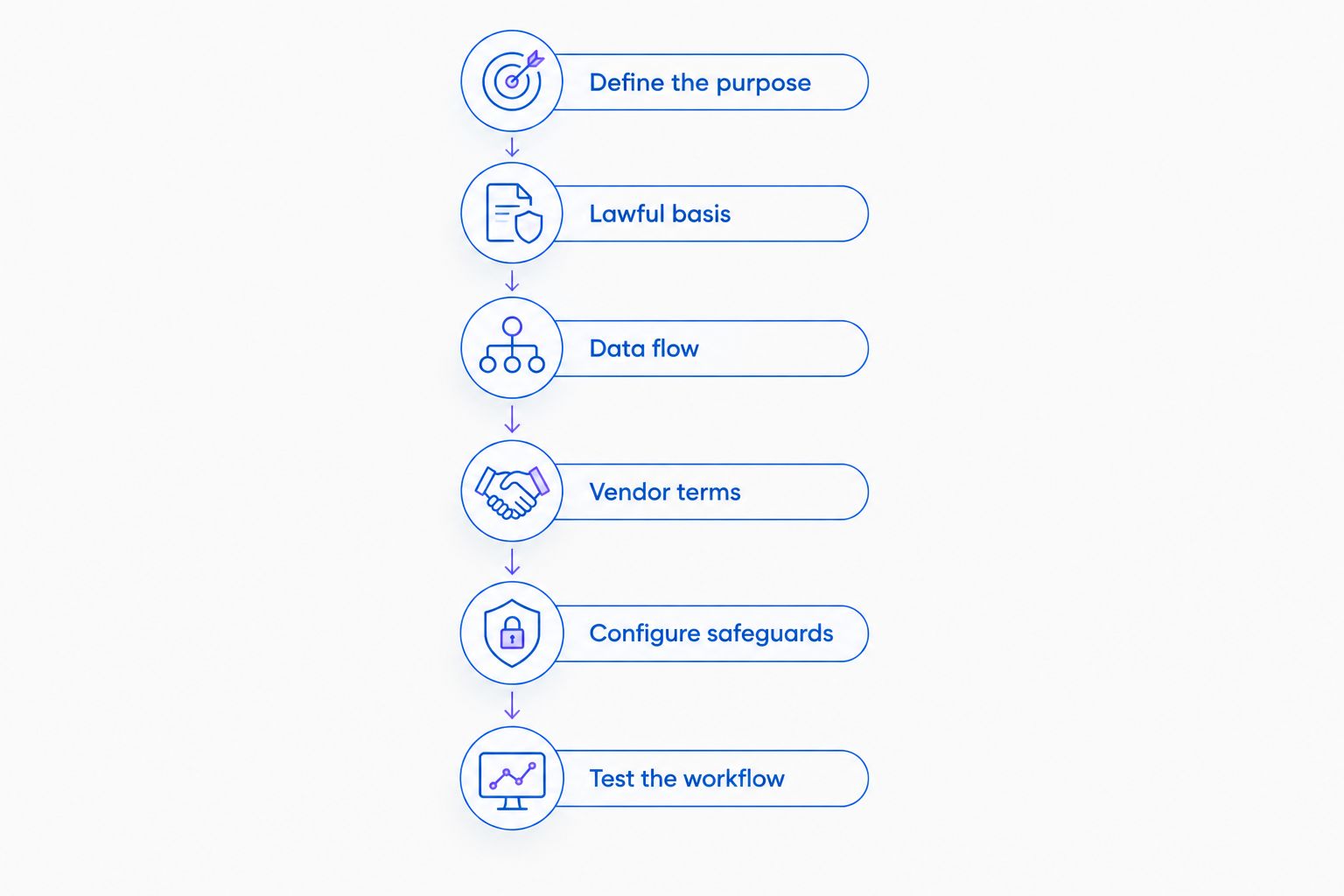
Approve the processing purpose and data flow before enabling customer calls.
Document the outcome for each purpose rather than giving the entire app a single compliance label. A workflow approved for answering delivery questions does not automatically authorize promotional calls or indefinite transcript storage.
Order support, recordings, and cart recovery need different checks
These workflows use overlapping customer data but serve different purposes. Assess each workflow separately. The table identifies the benefit and the compliance limitation, not a blanket legal approval.
Inbound order support
- Best for: Customers asking about existing orders
- Operational benefit: Answers a specific service request
- Compliance limitation: Contract necessity applies only where processing is objectively necessary; authenticate before disclosure
Refund handling
- Best for: Customers requesting a policy-based resolution
- Operational benefit: Connects the request to the relevant order
- Compliance limitation: Financial actions need controlled permissions; assess consequential automated decisions
Recorded support calls
- Best for: A defined review or dispute purpose
- Operational benefit: Preserves the conversation for that purpose
- Compliance limitation: Requires a lawful basis, notice, retention limits, and applicable national recording checks
Outbound cart recovery
- Best for: Merchants with a legally permitted marketing workflow
- Operational benefit: Contacts shoppers about an unfinished purchase
- Compliance limitation: Requires separate direct-marketing and national calling-rule checks
Inbound order support: restrict access to the request
A delivery-status call rarely needs the customer's complete purchase history. Give the agent the information necessary to answer the question, and establish a proportionate identity check before revealing an address or changing an order.
Do not read account details aloud merely because the incoming number matches a customer record. Shared phones and reassigned numbers make caller ID an insufficient standalone safeguard for sensitive disclosures.
Call recording: justify storage separately
Processing speech during a call and retaining an audio recording are different activities. A recording needs its own purpose, lawful basis, notice, and retention decision; a transcript remains personal data even if you delete the audio.
National confidentiality and recording laws can add requirements beyond GDPR. Review the rules applicable to the call instead of treating a recorded announcement as universal permission.
Cart recovery: assess marketing permission first
An abandoned-cart call seeks to encourage a purchase. It does not become transactional support simply because the shopper entered a phone number during checkout.
The ePrivacy Directive and national implementing rules govern marketing calls alongside GDPR. Automated calling systems without human intervention used for direct marketing require prior consent under Article 13 of the directive; assess how your AI calling setup fits the applicable national rules before launch.
Why GDPR requirements vary between phone workflows
The compliance burden changes with the processing, not with the voice agent's marketing category. These factors determine what your 2026 review must cover:
- Purpose: Resolving an order question and promoting an unfinished purchase require different justification.
- Data sensitivity: A conversation about a supplement or skincare purchase can reveal health information. Special-category processing requires an Article 9 condition as well as an Article 6 basis.
- Storage: Live audio, stored recordings, transcripts, and summaries create different retention and access requirements.
- Processing locations: Non-EEA hosting or access can trigger international-transfer requirements.
- Decision consequences: An order-status response is different from a solely automated decision with legal or similarly significant effects.
- National calling rules: Marketing and recording requirements depend on the relevant jurisdiction, not just the customer's checkout preferences.
What should you ask an AI phone support vendor?
Ask for evidence tied to the service you will actually enable. A security description does not replace contractual commitments, and a hosting location does not explain every subprocessor's access.
Request the data processing agreement, subprocessor list, processing locations, retention controls, security measures, incident process, and support for access and deletion requests. Check whether customer conversations are used for the provider's own model training or other independent purposes.
Avasales is best for Shopify merchants seeking phone support and abandoned-cart calling in one app. It answers support calls 24/7, handles orders and refunds, and makes outbound cart-recovery calls. Its operational fit does not establish GDPR compliance for a particular store's configuration.
Avasales offers a 7-day free trial, setup in minutes, and zero commission on recovered revenue. Use the evaluation period to test the support workflow and examine privacy documentation before enabling EU customer calls. The benefit is continuous phone coverage; the constraint is that support and marketing still need separate approval.
Do not infer EU-only processing, restricted model training, particular deletion controls, or a compliant transfer arrangement from the app's Shopify integration. Confirm those points in the applicable terms and technical documentation.
Does GDPR require consent for AI support calls?
GDPR does not require consent for every AI support call. Article 6 provides several lawful bases, including contract necessity and legitimate interests, but each has conditions.
If you rely on legitimate interests, document the purpose, necessity, and balancing assessment. If you rely on consent, make it specific, informed, freely given, and withdrawable; consent to one purpose does not authorize unrelated uses.
A 2026 consent review should distinguish answering a requested support call from recording it or initiating a marketing call. National telecommunications rules can require consent even where a GDPR lawful basis exists.
Can AI phone support process EU customer data outside Europe?
GDPR permits international transfers when the applicable Chapter V requirements are met. EU hosting is not a universal requirement, and EU hosting alone does not prove that all processing stays within the EEA.
Check remote access, transcription services, model providers, and subprocessors. Transfers can rely on an applicable adequacy decision or appropriate safeguards, such as standard contractual clauses, with the required assessment and supplementary measures where necessary.
A transfer review in 2026 should identify the recipient and the exact arrangement. A provider's headquarters, a general statement about encryption, or a server-region selector is not enough.
Can a voice agent refuse refunds without human review?
GDPR Article 22 addresses decisions based solely on automated processing that produce legal or similarly significant effects. Not every automated support response falls within that provision, but consequential refund decisions need an explicit assessment.
Separate routine execution of a customer's authorized request from deciding a disputed entitlement. Where Article 22 applies, its exceptions and safeguards matter, including meaningful human intervention where required.
Keep disputed financial decisions out of an unchecked automation path. Give customers a usable way to contest the outcome, and ensure the reviewer can change it rather than merely repeat the agent's answer.
Retention, rights requests, and incident handling
Set retention according to a documented purpose. GDPR does not prescribe one universal storage period for AI call recordings, so copying another merchant's retention setting does not establish compliance.
Distinguish audio, transcripts, call summaries, consent evidence, and order records. They serve different purposes and need separate decisions. Deletion must also account for processor-held copies and backup handling under the documented policy.
For access and other data-subject requests, GDPR Article 12 generally requires action within one month of receipt. An extension of two further months is permitted where necessary because of complexity or request volume, with notice of the extension and reasons within the initial month.
For a personal-data breach, Article 33 generally requires notification to the supervisory authority within 72 hours of awareness unless the breach is unlikely to result in a risk to individuals' rights and freedoms. A processor must notify the controller without undue delay.
Your 2026 operating procedure should therefore assign responsibility for requests and incidents before launch. Test whether you can locate a customer's call data, export the relevant information, restrict access, and coordinate deletion across providers.
FAQ
Is AI phone support compliant with GDPR for EU customers?
AI phone support can comply with GDPR when its actual processing meets lawful-basis, transparency, minimization, security, processor, and transfer requirements. Compliance depends on the workflow and configuration, not the use of AI alone.
Do I need customer consent before an AI agent answers a support call?
GDPR does not require consent for every support call; another lawful basis can apply where its conditions are satisfied. Recording, marketing, and national telecommunications rules require separate checks.
Can I use an abandoned checkout phone number for an AI sales call?
Entering a phone number at checkout does not automatically authorize an AI marketing call. Assess GDPR, applicable ePrivacy rules, and national direct-marketing requirements before calling.
Does GDPR require AI call data to stay in the EU?
GDPR does not impose a universal EU-only hosting requirement. Transfers outside the EEA must meet the applicable Chapter V requirements, including safeguards or an applicable adequacy decision.
How long can I keep AI support call recordings?
GDPR sets no universal retention period for AI support recordings. Choose and document a period justified by the specific purpose, and apply deletion rules to audio, transcripts, and processor-held copies.
How quickly must I answer a request for call data?
GDPR generally requires action within one month of receiving a data-subject request. A justified extension of two further months is available for complexity or request volume, with timely notice to the requester.
Is Avasales automatically GDPR-compliant for my Shopify store?
Using Avasales does not automatically make your Shopify store's phone workflow GDPR-compliant. Review the applicable processor terms, data flows, transfers, retention, and separate permissions for outbound marketing.
One last thing
GDPR is not the only rule affecting an AI phone agent. EU AI Act Article 50 transparency obligations apply from 2 August 2026, including requirements concerning systems intended to interact directly with people, subject to the provision's conditions and exceptions.
Plan a clear disclosure that the caller is interacting with an AI agent, alongside the relevant privacy information. Saying that a call is recorded does not communicate the same thing as explaining that the speaker is automated.
Before launch, test the opening disclosure, an identity check, a disputed refund, and a deletion request. A privacy notice supports accountability; a working call process puts it into practice.