Is an AI voice call better than a chatbot for cart recovery?
AI voice call vs chatbot cart recovery: choose by shopper needs, not channel hype. Compare strengths, limits, and completed Shopify orders in a fair test.
November 6, 2026
An AI voice call is the better cart-recovery choice when you need to discuss a checkout blocker with a shopper who has agreed to phone contact; a chatbot fits shoppers who want written help while browsing. Neither channel wins universally: compare completed orders and customer experience, not calls answered against chat messages sent.
TL;DR
- Avasales offers a 7-day free trial, setup in minutes, and zero commission on recovered revenue.
- AI voice call vs chatbot cart recovery: choose by contact permission, checkout blocker, and shopper preference.
- Choose voice for spoken follow-up; choose a chatbot for written help during an active store visit.
- Measure abandoned cart recovery through completed Shopify orders, not conversations or checkout-link clicks.
Is an AI voice call better than a chatbot for cart recovery?
Choose an AI voice call for a permitted phone conversation about an unfinished purchase. Choose a chatbot for written assistance while the shopper is engaged with your store. These are different contact opportunities, so a useful 2026 comparison starts with the shopper's situation rather than the interface.
Avasales provides Shopify merchants with outbound abandoned-cart calls alongside phone customer support. That makes voice relevant when your recovery process needs a conversation beyond the storefront, rather than another message inside it.
Best for
- AI voice call: Shoppers open to discussing an unfinished checkout by phone
- Chatbot: Shoppers seeking written help during a store visit
Contact requirement
- AI voice call: An appropriate phone number and permission for the intended contact
- Chatbot: Access to the chat experience and a shopper willing to engage
Main strength
- AI voice call: Spoken questions and follow-up in the same conversation
- Chatbot: Written answers the shopper can read while browsing
Main limitation
- AI voice call: An unanswered or declined call does not create a conversation
- Chatbot: An on-site chat session does not reach someone who has left
Checkout action
- AI voice call: Direct the shopper to an approved checkout route
- Chatbot: Present an approved checkout route within the conversation
Measurement priority
- AI voice call: Eligible shoppers who complete an order after assignment
- Chatbot: Eligible shoppers who complete an order after assignment
A chatbot connected to messaging channels has a different reach from an on-site widget. Define the actual deployment before comparing it with outbound calling; the word chatbot alone does not describe how a shopper receives a message.
Why this matters
Cart recovery is a purchase-assistance problem, not just a reminder problem. Your next action should depend on whether the shopper needs an answer, a working checkout route, or no further contact.
A spoken explanation helps only if the shopper accepts the call and the agent answers accurately. A written reply helps only if the shopper sees it and can act on it. Adding a channel without those conditions adds activity, not proof of recovery.
For your 2026 channel review, keep eligibility, contact attempts, conversations, and completed orders separate. Otherwise, a busy dashboard can conceal a recovery process that fails at the final step.
AI voice calls: best for permitted conversational follow-up
Use voice when a shopper has an unresolved question that deserves back-and-forth discussion and phone outreach is appropriate. The practical advantage is the format: the shopper can explain the concern, hear an answer, and ask a follow-up without typing.
Avasales is best for Shopify merchants seeking voice-based cart recovery alongside phone customer support. Its stated functions include outbound abandoned-cart calls, order and refund support, and answering customer support calls 24 hours a day, 7 days a week.
That support coverage is not a recommendation to place recovery calls around the clock. Set outbound contact rules separately, including appropriate calling times and how requests to stop contact are handled.
Voice has clear limits. A shopper can decline the call, prefer writing, or ask a question outside the approved information. Assess how the proposed workflow handles those outcomes before treating voice as a replacement for another channel.
Ask the provider to demonstrate the full conversation, including an uncertain answer and a shopper who declines assistance. A successful demonstration should show boundaries, not just a polished opening line.
Chatbots: best for written help during an active visit
Choose a chatbot when your shopper is already on the store and wants a written answer without joining a phone conversation. Written chat gives the shopper something to reread while checking product information or returning to checkout.
Its strengths depend on the implementation. Check which store information the chatbot can access, which answers it can provide, and whether it can present the correct checkout destination. Do not assume every chatbot has order access or outbound messaging.
The limitation of an on-site chatbot is its location. Once the shopper leaves, that widget is no longer an active conversation unless another supported channel continues it.
Keep a chatbot when it serves written, in-session questions well. Add voice only for a defined recovery need; replacing useful chat with phone calls simply because voice is available is not a channel strategy.
For a closer look at the boundary between text and telephony, read whether AI chatbots can handle phone calls.
Why cart-recovery results vary
The following factors belong in your comparison because they determine whether either channel can provide useful help:
- Contact eligibility: Separate shoppers eligible for phone outreach from those you can assist only through the current chat session. Compare like with like when both channels are available.
- Shopper preference: Respect a request for written help or no further contact. A channel preference is a routing instruction, not an objection to overcome.
- Checkout blocker: Identify the actual question before offering an answer. A reminder does not resolve uncertainty about a store policy or an unfinished checkout step.
- Approved information: Give the agent accurate store rules and clear limits. Neither a spoken answer nor a written answer should invent an exception.
- Checkout route: Confirm that the shopper receives the correct approved destination. An informative conversation still needs a usable path back to purchase.
- Measurement rules: Define attribution before launching. A completed order after a conversation does not, by itself, prove the conversation caused it.
These factors also explain why a single channel-wide conversion claim is a weak buying criterion. Your store needs evidence from the shoppers and workflows you intend to serve.
How should you test voice against chat in 2026?
Build the test around a common business outcome: completed Shopify orders among shoppers assigned to each eligible recovery workflow. Decide the attribution window and exclusions before starting, then keep those definitions consistent.
- Define eligibility. Identify which shoppers qualify for each workflow, including appropriate contact permission. Separate groups with different contact opportunities instead of combining them into one headline comparison.
- Identify the blocker. Use the same approved store information for both channels. Record whether the conversation addressed the shopper's question or merely delivered a reminder.
- Approve the response. Specify permitted explanations, checkout destinations, and any text links. Define what happens when a request falls outside those boundaries.
- Check the outcome. Match recovery activity to completed orders using a consistent method. Review refunds, cancellations, and other recovery messages before interpreting the result.
- Review contact quality. Examine unanswered calls, abandoned chats, unresolved questions, and requests to stop. Read or listen to representative conversations rather than relying only on totals.
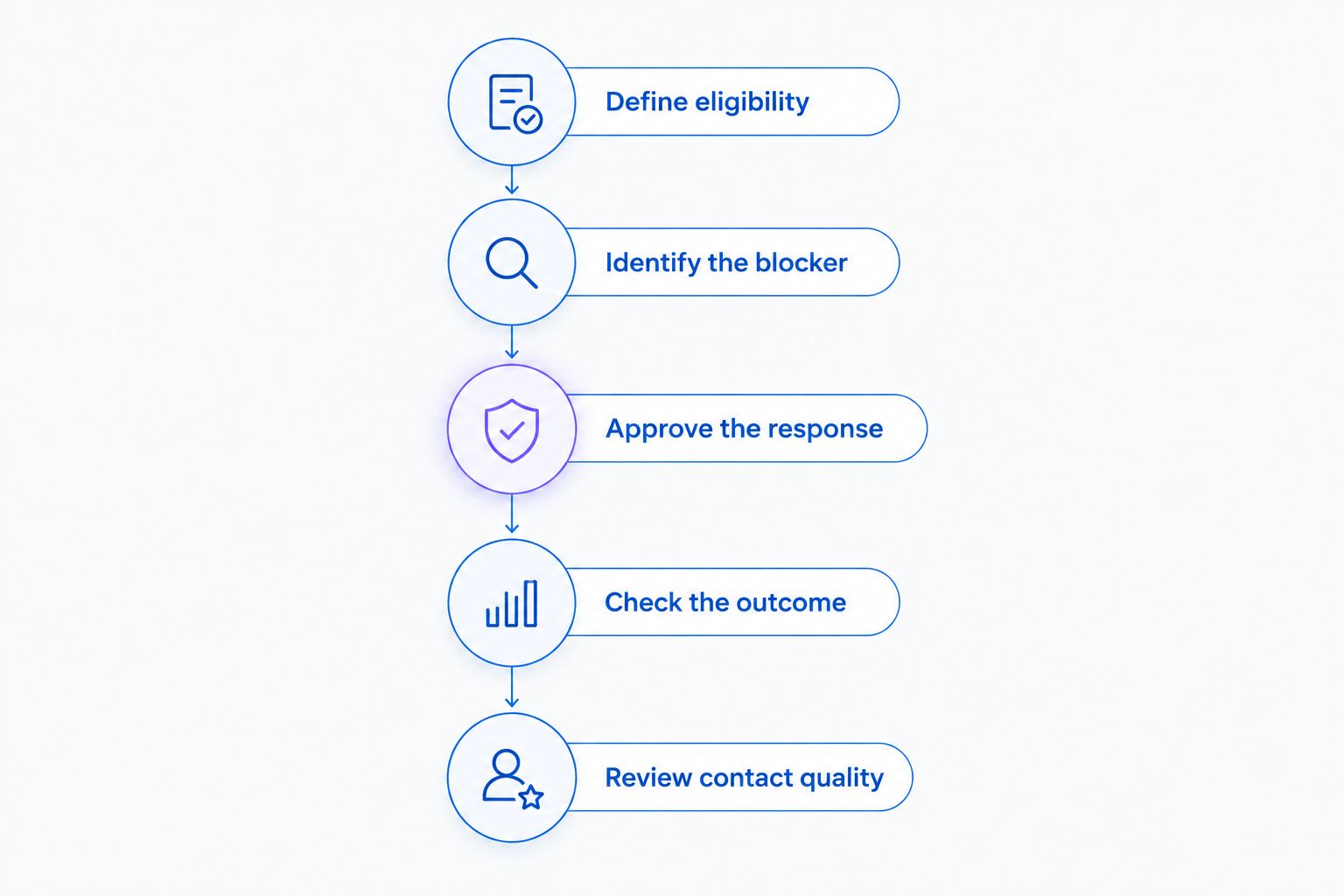
Compare completed orders only after defining who each channel can appropriately contact.
Keep your 2026 test log separate from acquisition reporting. Website clicks, app installs, trial starts, and paid customers describe different stages of software adoption; none is a recovered Shopify order.
Also separate a checkout-link click from a purchase. A link click shows progress toward checkout, while a completed order confirms the transaction. Reporting both makes the remaining friction visible without overstating recovery.
What does the available performance figure establish?
Avasales reports an internal merchant average of 37x for outbound abandoned-cart voice calls. Individual results vary. Treat that figure as a brand-reported result for that activity, not as evidence that voice outperforms a chatbot.
The 37x figure does not establish a voice-versus-chatbot winner. A direct comparison requires consistent definitions, comparable eligible shoppers, and an explicit measurement method. Use your own test to answer the channel question rather than treating an internal average as a forecast.
Can you use voice calls and a chatbot together?
Voice calls and a chatbot can serve different stages of the same recovery process. Keep chat available for written questions during the visit, then consider permitted phone follow-up for an unfinished purchase that still needs assistance.
Define contact ownership so channels do not create overlapping outreach. Stop recovery activity after a completed purchase or a request to stop, and check whether your proposed systems can enforce those rules before deployment.
Should you replace your chatbot with voice calls?
Replace your chatbot only if the proposed phone workflow meets the needs that chat currently serves. A shopper who wants to read an answer while browsing does not automatically benefit from a call instead.
For your 2026 review, judge replacement and addition separately. Adding outbound recovery addresses a different question from removing an existing written support channel.
Can voice recovery work without offering a discount?
Voice recovery does not require a discount as part of the conversation. Start by identifying the unanswered question and explaining the relevant approved information.
Do not make an incentive the default response to every abandoned checkout. Keep any offer within your store's explicit rules, and assess completed orders after refunds and cancellations rather than celebrating the conversation alone.
Start with a bounded Shopify trial
Avasales offers a 7-day free trial, setup in minutes, and zero commission on recovered revenue. Use the trial to inspect conversation quality and checkout routing before deciding how broadly to deploy voice recovery.
Begin with approved store information and clear contact boundaries. Test an unanswered call, a declined conversation, a question the agent cannot resolve, and a shopper who needs a checkout link. Confirm how each outcome is recorded.
Check current plan terms and usage charges in the Shopify App Store before committing. Zero commission on recovered revenue describes the commission policy; it does not describe every possible service charge.
Test your cart-recovery workflow
Use the 7-day free trial to assess call quality, approved answers, and checkout recovery.
FAQ
What's better for abandoned carts, an AI voice call or a chatbot?
Choose an AI voice call for permitted spoken follow-up and a chatbot for written help during an active visit. Compare completed orders among comparable eligible shoppers before declaring a performance winner.
Can a chatbot recover a cart after the shopper leaves my store?
An on-site chatbot widget cannot continue an active conversation with a shopper who has left the site. Check whether the specific chatbot supports another messaging channel before including off-site recovery in your comparison.
Does Avasales offer a free trial for Shopify cart recovery?
Avasales offers a 7-day free trial, setup in minutes, and zero commission on recovered revenue. Check current plan terms and usage charges in the Shopify App Store before committing.
Does the 37x internal average prove voice is better than chat?
The 37x internal merchant average for outbound abandoned-cart voice calls does not establish a comparison with chatbots. Individual results vary, and your channel decision requires comparable shoppers and consistent measurement.
Should I count a checkout-link click as a recovered cart?
A checkout-link click is not a recovered cart. Track the click separately from a completed Shopify order so your reporting distinguishes engagement from a purchase.
Can I keep my chatbot while testing phone recovery?
Keep your chatbot if it provides useful written assistance while you test permitted phone recovery. Define contact ownership and stopping rules so shoppers do not receive overlapping recovery outreach.
Does round-the-clock phone support mean I should call abandoned carts overnight?
Round-the-clock inbound support does not determine appropriate outbound recovery times. Set separate calling rules based on the intended contact, applicable requirements, and shopper preferences.
One last thing
Test the stop condition before the opening pitch. Complete a test checkout, decline further contact, and introduce an unresolved question. Check how the workflow responds to each event before expanding it.
A recovery process needs more than a convincing conversation. It needs accurate answers, an approved route back to checkout, and a reliable reason to stop contacting the shopper.