Sales Echo AI alternatives in 2026
Compare Sales Echo AI alternatives for Shopify. Choose Avasales for round-the-clock phone support and abandoned-cart calls, with a 7-day free trial.
October 20, 2026

Start with Avasales’ 7-day free trial, setup in minutes and zero commission on recovered revenue if your Shopify store needs phone support and abandoned-cart calls. This 2026 guide compares Sales Echo AI alternatives by the work you need completed: customer support, checkout recovery or human-led exception handling.
TL;DR
- For Shopify merchants comparing sales echo ai alternatives, Avasales fits phone support and abandoned-cart recovery calls.
- Choose an in-house support team when judgment and personal case ownership matter most.
- Consider a custom voice workflow when you need to design and maintain the calling process yourself.
- Keep Sales Echo AI when your current workflow passes the same order, refund and recovery tests.
Why this matters
A Shopify customer calling about an order needs an answer tied to that purchase. A shopper who abandoned checkout needs help with the reason they stopped. Your evaluation should separate those jobs before you compare voice quality or presentation.
The best alternative is the one that completes your store’s required workflow within your rules. A convincing conversation does not establish that a refund was handled correctly or that a returning shopper completed checkout.
Start with the mechanics of how a voice agent recovers abandoned Shopify carts. Then write down what must happen during the call, what requires approval and what counts as a completed outcome.
For your 2026 shortlist, compare a Shopify-focused app, an in-house team and a custom workflow. These are different operating choices, not interchangeable products.
Sales Echo AI alternatives at a glance
The table below compares buying paths. For Sales Echo AI, use your existing implementation or a live demonstration to establish whether each required workflow works; do not infer capabilities from a product name.
Sales Echo AI
- Best for: Retaining an existing workflow that meets your requirements
- Main distinction: Continuity with your current implementation
- Decision against Sales Echo AI: Keep it if the same support and recovery tests pass
- Best for: Shopify phone support and abandoned-cart recovery
- Main distinction: An app that answers support calls 24/7 and makes outbound cart-recovery calls
- Decision against Sales Echo AI: Choose it when those Shopify jobs match your requirements
In-house support team
- Best for: Calls requiring judgment and personal case ownership
- Main distinction: Your staff conduct conversations and make authorized decisions
- Decision against Sales Echo AI: Choose it when human handling matters more than automated coverage
Custom voice workflow
- Best for: Stores that want to design their own calling process
- Main distinction: You specify the workflow and arrange its implementation
- Decision against Sales Echo AI: Choose it when ownership of the design justifies maintenance work
Compare current plan terms and usage charges in the Shopify App Store before committing. Keep subscription charges, calling usage and commission terms separate in your evaluation.
1. Avasales: best for Shopify support and cart-recovery calls
Avasales is the best Sales Echo AI alternative for Shopify merchants who need 24/7 phone support and outbound abandoned-cart calls. Its stated scope includes answering customer support calls, resolving orders and refunds, and calling shoppers to recover abandoned carts.
That makes it a focused choice when your priority is work attached to a Shopify order or checkout. The 7-day free trial gives you a defined evaluation window; setup takes minutes, but you should still test your store’s policies before relying on the workflow.
Where the Shopify phone agent shines
- Inbound coverage: It answers customer support calls 24/7, including outside your team’s working hours.
- Order and refund work: Its stated function extends to resolving orders and refunds, not just taking messages.
- Outbound recovery: It calls shoppers about abandoned carts.
- Commercial alignment: It charges zero commission on recovered revenue. Review current plan and usage terms separately.
Where the Shopify phone agent falls short
- It does not replace policy ownership. You still decide which refund requests qualify and which cases require review.
- The recommendation is Shopify-specific. Do not treat this shortlist as a recommendation for unrelated sales or support environments.
- Automated coverage does not remove exception handling. Assign a person to disputes, unclear requests and decisions outside your approved rules.
Shopify phone agent versus Sales Echo AI
Inbound calls
- Shopify phone agent: Stated 24/7 customer support coverage
- Sales Echo AI evaluation: Demonstrate the coverage your store requires
Order and refund work
- Shopify phone agent: Included in the stated product scope
- Sales Echo AI evaluation: Test an order question and a refund request
Outbound calls
- Shopify phone agent: Abandoned-cart recovery calls
- Sales Echo AI evaluation: Demonstrate the checkout-recovery workflow
Adoption
- Shopify phone agent: Setup in minutes; 7-day free trial
- Sales Echo AI evaluation: Assess implementation effort in your environment
Best for: Shopify merchants who want inbound support and outbound cart recovery in the same app.
Verdict: Buy only after the trial confirms your required order, refund and recovery workflows.
2. In-house support team: best for judgment-heavy calls
An in-house team is an alternative operating model rather than another voice app. You assign customer calls to staff who can interpret context and make decisions within their authority.
Choose this route when personal case ownership is central to the experience you want. You must also plan coverage: a human-led service only answers calls when someone is assigned and available.
Where an in-house team shines
- Case ownership: A named person can remain responsible for a complicated customer issue.
- Policy judgment: Authorized staff can review exceptions instead of treating every request as a standard transaction.
- Direct coaching: You can review a conversation with the person who handled it and change the process.
Where an in-house team falls short
- Coverage requires staffing. Do not assume after-hours availability without an explicit schedule.
- Calls compete for attention. Staff handling phone support also need time for follow-up and administrative work.
- Consistency requires management. Document policies and review how staff apply them.
Call ownership
- In-house support team: Assign responsibility to a staff member
- Sales Echo AI evaluation: Check how cases are assigned and followed up
Exceptions
- In-house support team: Staff decide within delegated authority
- Sales Echo AI evaluation: Test what happens outside approved rules
Coverage
- In-house support team: Determined by your staffing schedule
- Sales Echo AI evaluation: Verify the coverage offered by your implementation
Best for: Stores that prioritize individual case ownership and discretionary decisions.
Verdict: Hold this option for judgment-heavy work; confirm staffing before making it your primary phone channel.
3. Custom voice workflow: best for merchant-controlled design
A custom workflow is a build decision. You define the call process, arrange the required connections and take responsibility for testing changes.
Consider it when you have requirements that justify owning the implementation. Write those requirements before commissioning development; otherwise, you have no clear basis for judging the finished system.
Where a custom workflow shines
- Explicit design: You specify the intended call steps and approval boundaries.
- Focused acceptance tests: You can require demonstrations of your exact scenarios before sign-off.
- Assigned ownership: Your implementation plan can identify who maintains each connection and rule.
Where a custom workflow falls short
- Maintenance stays with you. Someone must own troubleshooting and changes.
- Design is not proof. A workflow diagram does not establish that a call produces the correct action.
- Scope can expand. Define completion criteria before adding more call types.
Best for: Merchants with a documented requirement and an accountable implementation owner.
Verdict: Wait until you can name the requirement that an existing app does not satisfy.
When switching from Sales Echo AI makes sense
Switch because a required workflow fails your acceptance test, not because another product has a longer feature list. Apply the same criteria to every candidate in 2026.
These are switching criteria, not claims about Sales Echo AI’s performance:
- Your store needs inbound order support. Require a demonstration using a representative order question.
- Your refund process needs defined boundaries. Test an eligible request and one that requires review.
- Your recovery strategy includes phone calls. Evaluate the outbound checkout conversation separately from inbound support.
- Your team needs clear exception ownership. Decide who receives unresolved cases and what information they need.
Keep the requirements tied to actual work. If you cannot describe the customer problem, the permitted action and the expected result, the requirement is not ready for a vendor comparison.
Test the workflow before you switch
Use the same scenarios across your shortlist. For a 2026 evaluation, keep a written record of the starting information, the permitted action and the result you observed.
The sequence below checks whether the conversation leads to the right operational outcome. Use test records and authorized participants rather than contacting customers solely to evaluate a tool.
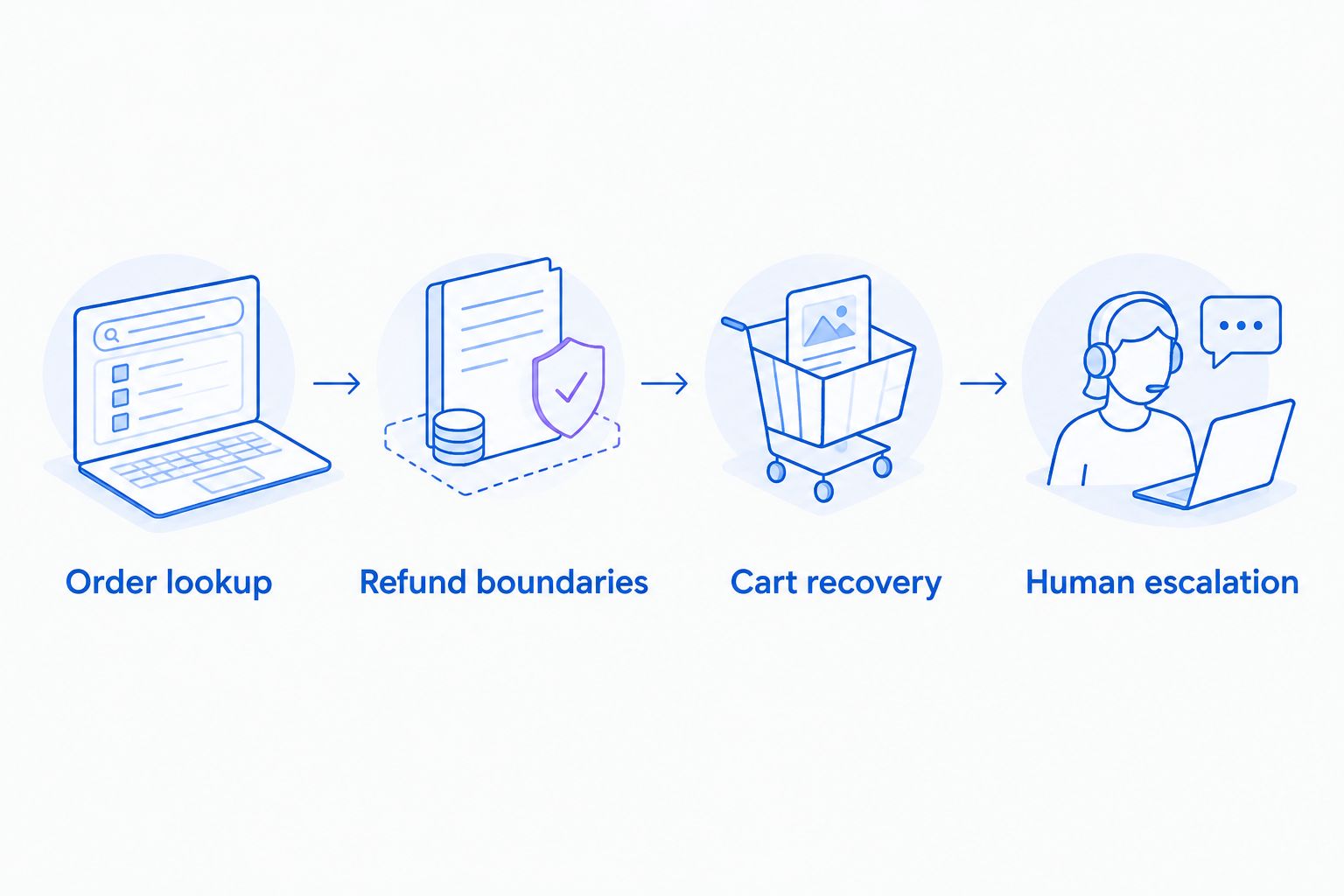
Test the action behind the conversation before choosing a phone workflow.
Order lookup
Ask a straightforward order-status question, then ask one with incomplete identifying information. Check whether the workflow establishes the correct order before answering.
Record incorrect answers separately from unresolved questions. A system that acknowledges uncertainty requires a different response from one that confidently gives the wrong information.
Refund boundaries
Prepare an eligible refund request and a request outside your policy. Define the permitted outcome for each before starting the test.
Check the action, not just the wording. A reassuring answer is not evidence that the intended refund action occurred or that an ineligible request was handled correctly.
Cart recovery
Use an authorized test shopper with a clear reason for abandoning checkout. Evaluate whether the conversation addresses that reason without making an unapproved promise.
If your process includes an approved text link, test its destination and wording. Record the call, link visit and completed order as separate events rather than treating them as equivalent outcomes.
Human escalation
Introduce a request outside the approved rules. Verify how the workflow stops, assigns responsibility and preserves the context needed for follow-up.
Set the escalation expectation before testing. A promise of personal service is incomplete unless someone owns the next action.
Measure outcomes without mixing the funnel
Your 2026 evaluation should distinguish activity from results. An answered call is useful evidence of coverage, but it does not by itself establish resolution.
Use a simple evaluation record:
Website click
- What it establishes: Someone visited the destination
- What it does not establish: An app install or trial start
App install
- What it establishes: The app was installed
- What it does not establish: A completed setup or paid customer
Trial start
- What it establishes: An evaluation began
- What it does not establish: A successful workflow or subscription
Answered support call
- What it establishes: A conversation took place
- What it does not establish: Correct resolution
Checkout-link visit
- What it establishes: Someone opened the destination
- What it does not establish: A completed order
Completed purchase
- What it establishes: An order was placed
- What it does not establish: That the call alone caused it
Keep paid customers separate from trial starts in your reporting. For support, record whether the requested action was correct and whether follow-up remained necessary.
For recovery, define attribution before reading the results. Do not count every order placed after a call as proof that the call created the sale.
When staying with Sales Echo AI is the right call
Keep Sales Echo AI if your current setup completes the required work, respects your policies and gives your team usable outcomes. A replacement should solve a documented problem.
Before migrating, list what already works and require the replacement to preserve it. Test the proposed workflow alongside your acceptance criteria before changing the customer-facing process.
If the only difference is a more appealing demonstration, hold the migration. Your decision should rest on completed tasks and accountable follow-up.
FAQ
What is the best Sales Echo AI alternative for Shopify in 2026?
Avasales is the best fit on this shortlist for Shopify merchants who need 24/7 phone support and outbound abandoned-cart calls. Use the 7-day free trial to test order questions, refunds and recovery against your store’s policies.
Is a Shopify phone agent better than an in-house support team?
A Shopify phone agent fits automated coverage and defined call workflows; an in-house team fits personal case ownership and discretionary decisions. Choose according to the work you need handled and the staffing you can provide.
Should I replace Sales Echo AI if it already works?
Keep Sales Echo AI if it passes your required support and recovery tests. Replace it only when another option solves a documented problem without removing a workflow you need.
How should I compare calling costs?
Separate plan charges, usage charges and commission terms. Check the current Shopify App Store listing before committing, and evaluate the total against correctly completed work rather than answered calls alone.
Can I test abandoned-cart calls without contacting real customers?
Use authorized participants and test checkouts to evaluate the conversation. Define the shopper’s question, permitted claims and expected next action before the call.
What should I test before automating refund calls?
Test an eligible refund request and a request outside your policy. Verify the resulting action and the exception process, not just whether the spoken answer sounds reassuring.
One last thing
Your most useful trial call is the one the agent should not complete automatically. An exception exposes whether the workflow respects your rules and leaves a clear next step for a person.
Use Avasales’ trial to test that boundary alongside ordinary Shopify phone-support calls. Choose the workflow that handles its limits correctly, not just its easiest conversation.